Study in a nutshell
Reviewers confirmed 99 of the top 100 matches in the cleaned sample by majority vote. They also found genuine Tigrinya among discarded passages.
A Tigrinya speaker can switch to a Latin keyboard and carry on a conversation in the same language. For software trying to identify the language, that small change can make a familiar word look like one it has never seen.
Four Google Research scientists found a way to spot some of that writing by borrowing spelling patterns from Amharic. Among the 100 highest-ranked passages in a cleaned collection of web text, speakers judged 99 to be Tigrinya by majority vote. The surprise was how much genuine writing turned up in the material the filters had thrown away.
One word can have several spellings
Tigrinya, spoken in the Horn of Africa, is usually written in the Geʽez script. Writing its words in Latin letters is called romanization. People doing this informally can make different choices about how to represent the same sound. The paper gives an example from Hindi. Its word for “dawn” appears as savera, saveraa, sawera and saweraa. A reader may recognize all four. Software trained on a single spelling gets fewer clues.
For Tigrinya, the team faced a circular problem. To find real examples on the web, they needed a tool that could recognize them. To teach the tool what to look for, they needed examples.
Borrowing a clue from Amharic
Amharic and Tigrinya share a script. The researchers had Amharic words paired with Latin spellings supplied by speakers. They used these pairs to learn how a standard, letter-by-letter rendering tends to change when a person writes it. Then they applied those patterns to 5,005 sentences from Tigrinya Wikipedia. They ran the process ten times, allowing different plausible spellings to appear.
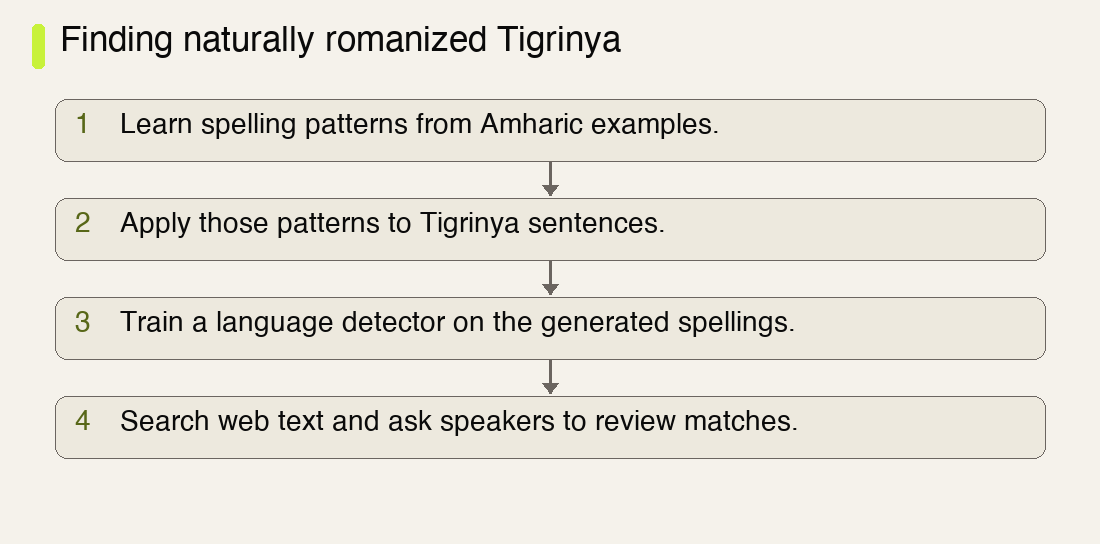
The team added these machine-made examples to a multilingual training collection. The resulting tool scanned web passages and ranked those it believed were Tigrinya. Three people familiar with the language, including two native speakers, checked its strongest matches.
What the filters kept, and what they lost
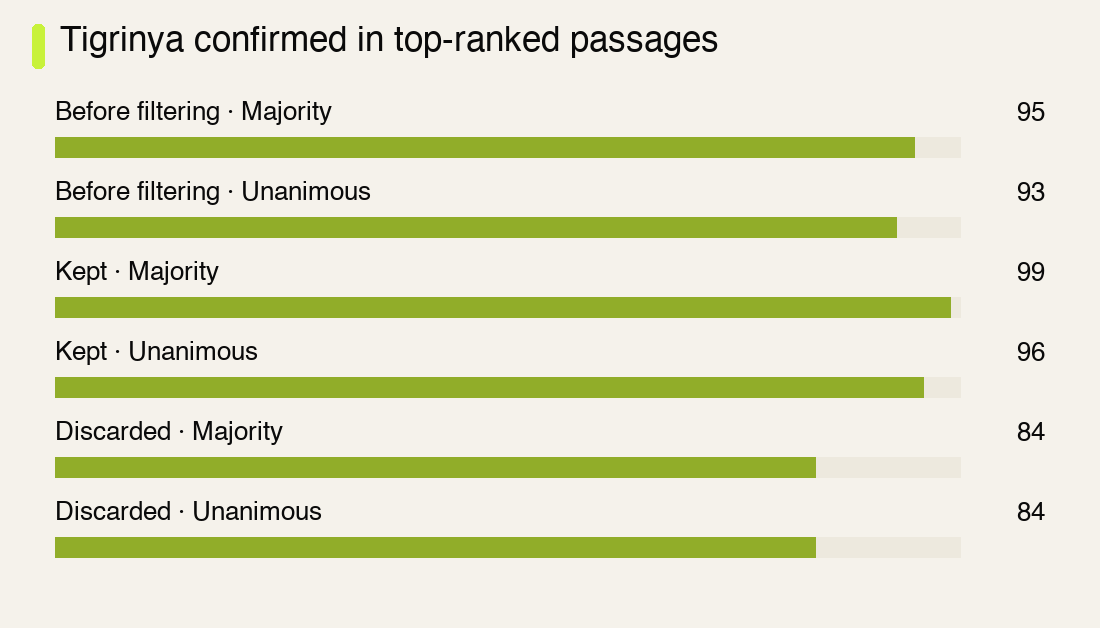
In the cleaned sample, at least two reviewers recognized Tigrinya in 99 passages, and all three agreed on 96. But all three also recognized Tigrinya in 84 of the 100 highest-ranked passages drawn from the discarded material. Cleaning helped remove junk such as strings of web addresses. It also cost the collection genuine examples.
Mixed-language writing made some decisions harder. In one passage, a reviewer recognized a Tigrinya word but thought most of the sentence was Amharic. Identifying one familiar word and deciding what language a whole message belongs to are different judgments.
What 99 out of 100 tells us
The team showed it could build a starter collection of real writing using examples from another language. The 99 describes the quality of the detector’s strongest matches after filtering. How much Tigrinya it missed across the web remains unknown. Unusual spellings could be especially easy to overlook, and the researchers found that borrowing patterns worked less well between Assamese and Bangla in a separate test.
For people building language tools, the next resource could begin with those verified passages. They show how people actually type, including choices a formal spelling guide might never record.
Conclusion
The method offers a way to start a collection of real writing from limited resources. Its strongest matches were reliable, but the study could not count all the texts that the detector missed.
Frequently asked questions
The words stay in the same language. The writer uses Latin letters to represent them.
It reveals a cost of filtering. All three reviewers recognized Tigrinya in 84 of the 100 strongest candidates from the discarded group.
Read the original research paper
Related study · Can a small AI read a contract better with a checklist?
Explore more Google research papers explained.