Study in a nutshell
Gemma’s contract-classification score rose from 67 to 83 on a 100-point scale. Its accuracy on logic questions moved from 67% to 70%.
Google researchers turned worked examples into a reusable set of instructions. A small AI model got better at spotting what a contract says, but the same technique barely moved its score on a logic exam.
Imagine a contract says a company “may retain one copy for its records.” Now consider the claim “The company must retain one copy.” Both sentences mention the same company, copy and records. The decision turns on two short words. Permission alone does not establish an obligation.
That invented example illustrates a problem Sanket Badhe and Deep Shah explored in a paper published in the industry track at ACL 2026. When a model repeatedly misses distinctions like this, could a more capable AI write it a guide to use on the next case?
How examples become instructions
The researchers call their method prompt-level distillation. Here, distilling means boiling many worked examples down to directions that apply beyond any one answer. Those directions go into the student model’s system prompt, the standing instructions it receives alongside each new question. Its internal settings, known as weights, stay fixed.
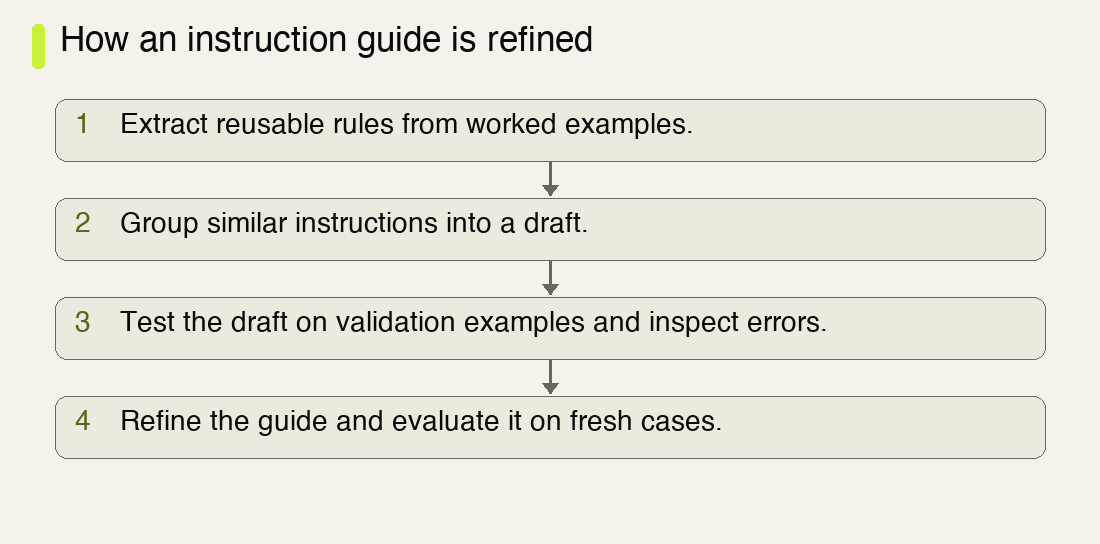
Consider the contract example again. A useful instruction might read, “When checking a claim about a duty, look for language that makes the action compulsory.” That advice could help with a new clause about deleting files, even if the original example concerned keeping them. The expensive part, working out which distinctions recur, happens while building the guide.
One model, three very different gains
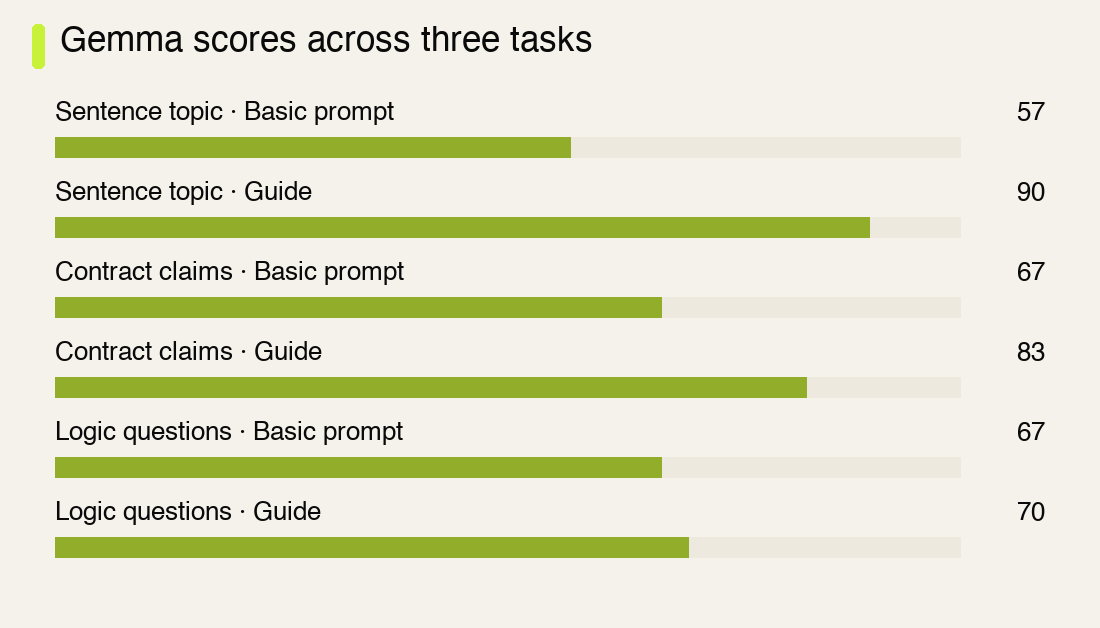
The biggest jump came on a version of StereoSet where the model identified whether a sentence concerned gender, race, profession or religion. The 33-point gain measures how well it identified the topic. Whether the model became less biased is a separate question.
On Contract-NLI, the model had to decide whether a contract supported a claim, contradicted it or left it unaddressed. Its score rose from 67 to 83. Both classification tasks use macro-F1. Each category earns a score for catching the cases that belong to it while avoiding false alarms, then the categories count equally in the average. An 83 on this scale does not mean 83 out of 100 contracts were read correctly.
LogiQA has a more familiar scoring rule. Accuracy is the percentage of multiple-choice questions answered correctly. Gemma rose from 67% to 70%. On the same test, another model, Mistral Small 3.1, finished at 56% with either prompt.
Would five good examples do the same job?
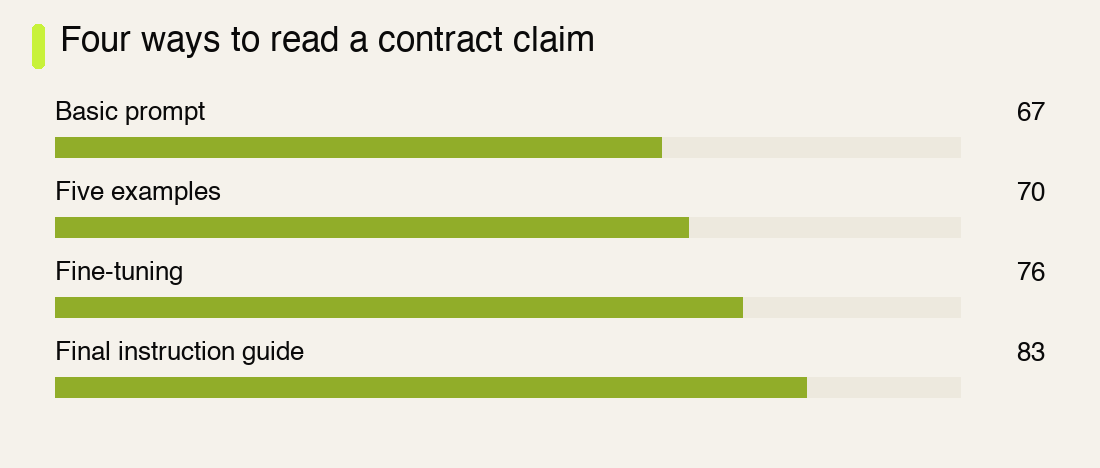
Showing Gemma five examples helped a little. Fine-tuning, a form of additional training that adjusts model parameters, helped more. The written guide scored highest of these four approaches on the contract test. Revising the guide after checking mistakes accounted for two points of its final score, from 81 to 83.
Where a checklist runs out
A checklist can remind a reader to look for an exception. It is less obvious how one line of advice could supply all the intermediate steps for an unfamiliar proof. The authors flag that distinction themselves. Their tests involved choosing among predefined answers. Whether the method helps with open-ended work or calculations that unfold differently each time remains an open question.
For someone building a tool that repeatedly reads the same kind of document, the study points to a practical experiment. Pick a recurring error, turn the missed distinction into a readable instruction and test it on fresh documents. A human can inspect the instruction. The fresh cases reveal whether the model can actually use it.
Conclusion
Reusable rules helped most when the model had to recognize recurring distinctions. The smaller gain on logic questions shows why a prompt should be tested on the actual task it will perform.
Frequently asked questions
Macro-F1 gives each category equal weight and accounts for missed cases and false matches. An 83 is not a count of correctly read contracts.
The instructions are supplied in the system prompt. The model’s learned weights stay fixed.
Read the original research paper
Related study · How researchers found Tigrinya hiding in plain sight on the web
Explore more Google research papers explained.