1. Synthesia SEO Benchmark Overview
Synthesia is more than an AI video platform. From an SEO perspective, it is a useful example of how a SaaS company can organize commercial demand around product features, business teams, specific use cases, industries, educational resources, trust, and conversion content.
A sample crawl of 51 pages, combined with manual reviews of the homepage, feature hub, Learning and Development page, and several use-case pages, reveals a sophisticated architecture. It also shows what happens when a site scales quickly: overlapping intent, copied template content, inconsistent claims, and increasingly complex navigation.
2. Synthesia SaaS SEO Architecture: Features, Teams, Use Cases and Industries
Synthesia Commercial Landing Page Structure
Synthesia does not ask one generic product page to rank for every query. It creates separate landing-page layers for the different ways people search.
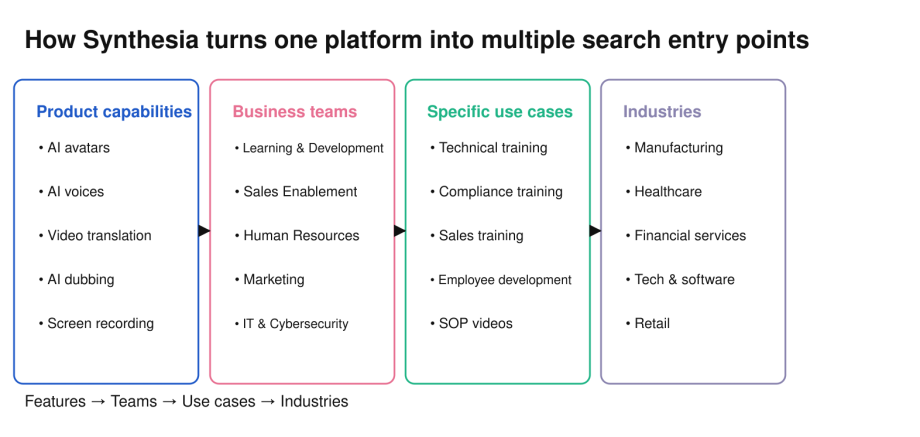
This architecture supports visitors at different levels of awareness. A user searching for an AI voice generator already knows the capability required. Someone searching for compliance training videos starts with a business problem. A visitor looking for AI video software in healthcare may need sector-specific security and workflow evidence.
A mature SaaS architecture can separate product capability, team solution, specific use case, and industry application—provided each page has a distinct search role.
3. Synthesia Site Navigation and SEO Information Architecture
Platform Mega Menu and Feature Taxonomy
The Platform menu divides the product into five workflow stages: Create, Localize, Manage, Publish, and Engage. This is more meaningful than presenting dozens of disconnected features in a flat list.

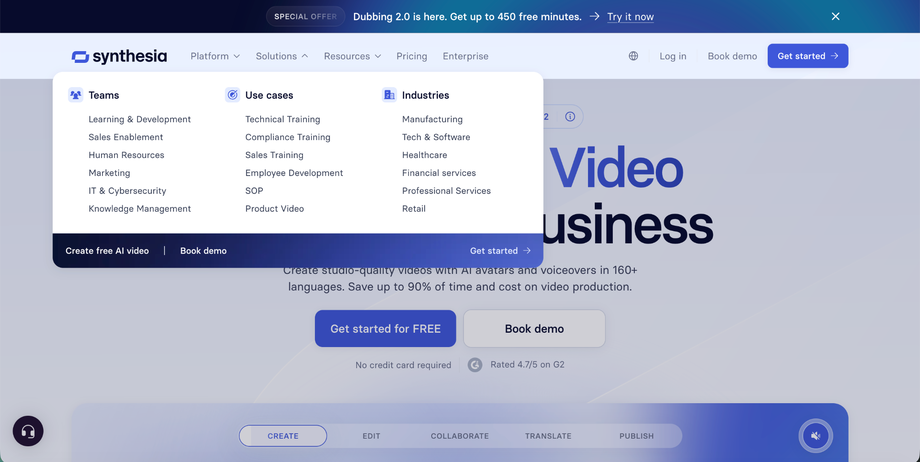
Solutions Pages by Team, Use Case and Industry
The Solutions menu separates Teams, Use cases, and Industries. These dimensions answer different questions: who uses the platform, what they create, and where the product is applied.
4. Keyword Mapping and Cannibalization Across Synthesia Training Pages
Recommended Keyword Ownership for Training Content
Training is one of Synthesia’s most developed clusters. The sampled crawl included a broad Learning and Development page, several specialized training use cases, and multiple educational resources.
| Query family | Primary page |
|---|---|
| AI training video platform | /learning-and-development |
| Technical training videos | /use-case/technical-training |
| Compliance training videos | /use-case/compliance-training |
| Sales training videos | /use-case/sales-training-enablement |
| Employee development videos | /use-case/employee-development |
| How to create training videos | One dedicated educational guide |
| Training-video examples | Supporting article or example gallery |
Table 1. Recommended keyword ownership across the training cluster. Several pages address closely related training searches, so assigning each URL a distinct query family, audience, and funnel role can help reduce internal competition.
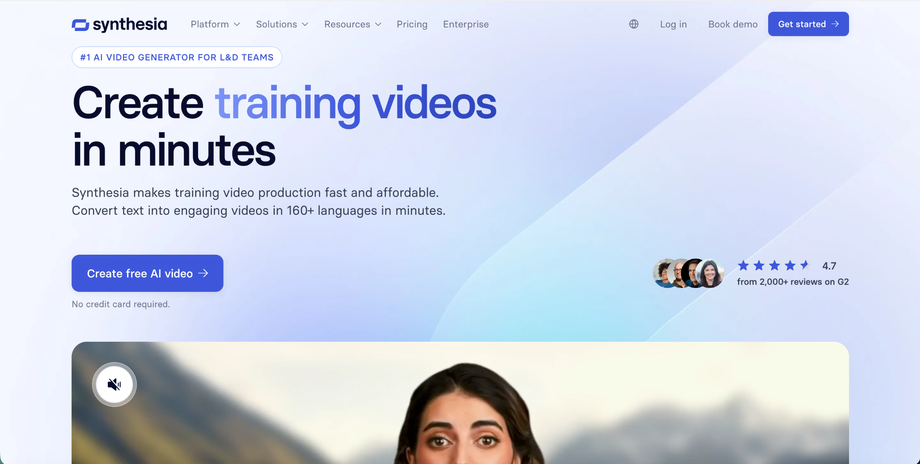
Learning and Development as the Parent Topic Hub
The Learning and Development page can serve as the main hub for the broader training topic, while the technical training, compliance training, sales training, and employee development pages focus on their respective workflows, examples, proof points, and FAQs. In simple terms, the hub covers training broadly and each supporting page explores one training need in detail.
5. Synthesia Product Claims, Reviews and Trust Metrics
Product and Adoption Metrics Used Across Synthesia
Across the benchmark sample, Synthesia generally supports its product positioning with specific product, adoption, and performance metrics rather than relying only on broad claims such as “save time” or “scale content.”
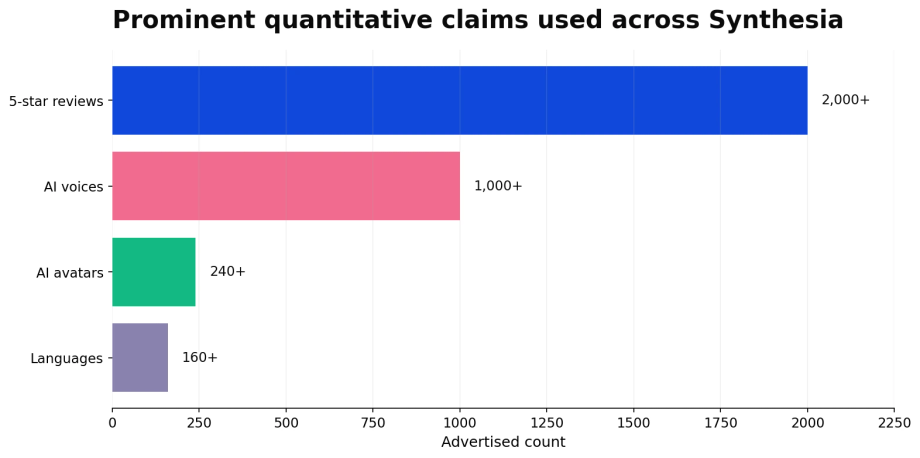
Recurring examples include adoption by more than 90% of Fortune 100 companies and savings of up to 90% in video-production time and costs.
A small number of audited pages showed differences in the wording of claims or in review totals, particularly between visible content and shared JavaScript. Although this was not a sitewide issue, it provides a useful benchmark example of how trust signals can become inconsistent as a large website evolves. A central claims registry could record each approved metric, its supporting evidence, its latest verification date, and the wording permitted across pages.
6. Customer Case Studies and Social Proof in SaaS SEO
Measured Customer Outcomes and SaaS Proof
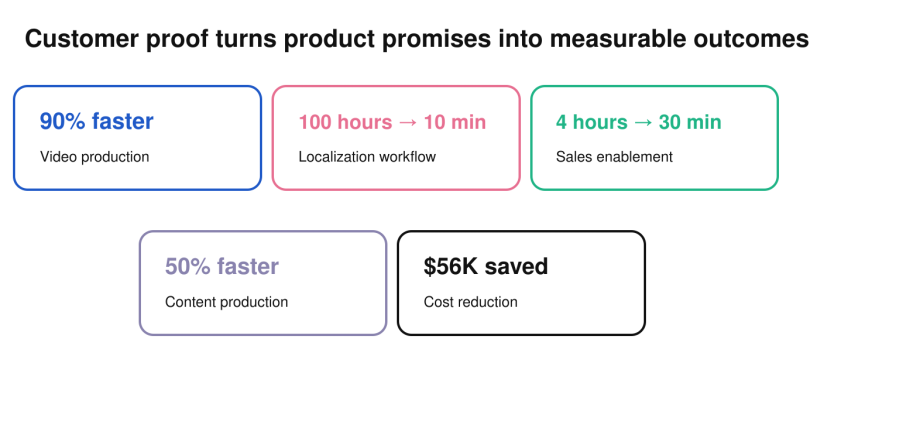
The homepage and use-case pages connect product benefits with recognizable customer outcomes, including faster production, reduced localization time, and measurable cost savings.
Customer Stories Embedded in Commercial Pages
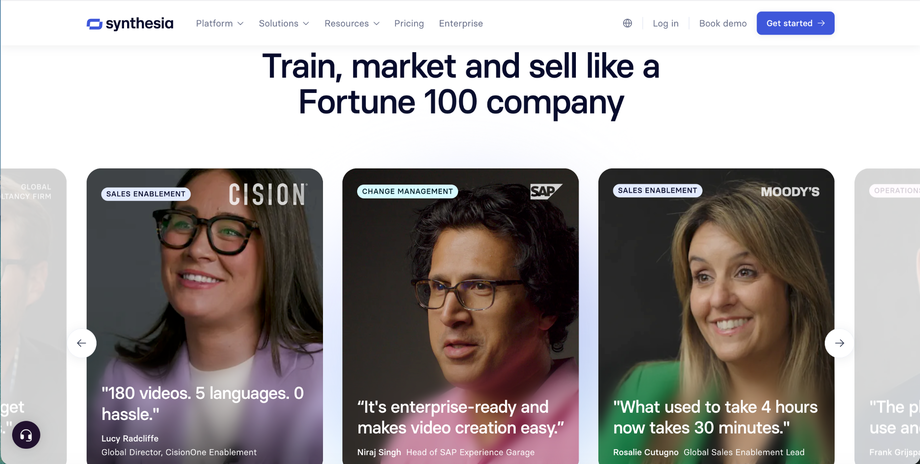
The strongest SaaS proof follows a clear sequence: claim, named customer, specific result, and complete case study.
7. Enterprise SEO Trust Signals: Security, Compliance and Responsible AI
Security, Compliance and Responsible AI Signals
Synthesia places trust elements in the Platform menu, homepage, footer, enterprise content, security pages, Responsible AI resources, and governance content.

This is particularly relevant for enterprise AI. Security is not merely legal information to find after a purchase decision; it helps users reach that decision.
8. Synthesia Internal Linking Strategy and Sitewide Navigation
Footer Links and Sitewide Page Discoverability
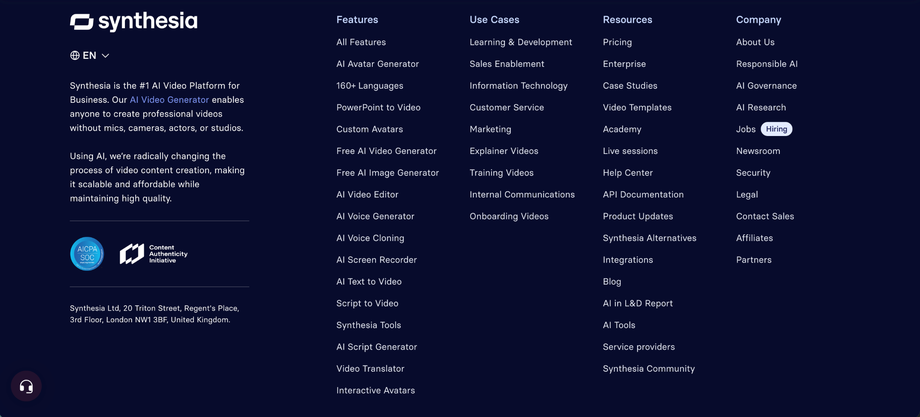
The footer exposes feature pages, use cases, resources, templates, integrations, company pages, and trust content, giving major sections broad sitewide visibility and supporting page discovery.
Internal-Link Value by Placement
| Internal-link placement | Relative contextual value | Primary SEO role |
|---|---|---|
| Relevant in-content link | 5/5 | Connects closely related pages within the main content and communicates the clearest topical relationship. |
| Related-page module | 4/5 | Supports further discovery through recommendations that are relevant to the current page topic. |
| Breadcrumb | 3/5 | Clarifies hierarchy and helps users and search engines understand the page’s position within the site structure. |
| Primary navigation | 3/5 | Provides strong sitewide discovery for important commercial and informational sections. |
| Footer link | 2/5 | Improves broad crawlability and access, but usually communicates a weaker contextual relationship. |
Table 2. Relative internal-link value by placement. Navigation and footer links support discovery, while relevant in-content links provide the strongest contextual and topical signals.
9. SEO Template Quality: Metadata, Headings and Content Consistency
Common SEO Errors in Scaled Landing Page Templates
The audits identified several signs of template leakage: a sales-training meta description referring to technical training, a sales page heading referring to compliance training, multiple H1s on industry pages, repeated grammatical errors, and inconsistent product claims.
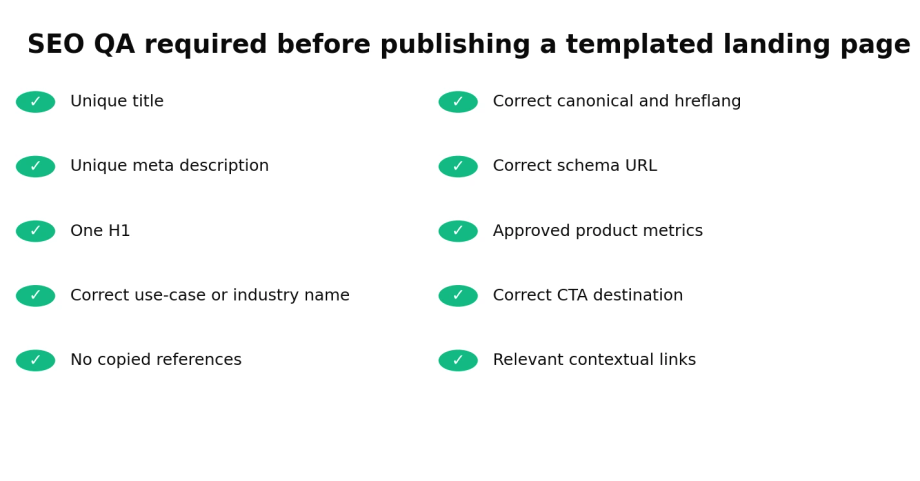
These are small errors individually, but together they show that scaling page production is easier than scaling editorial accuracy.
10. Technical SEO Risks: JavaScript, Video, A/B Testing and Performance
Visual UX Benefits Versus Technical SEO Costs
Synthesia uses videos, interactive demonstrations, mega menus, carousels, dynamic tabs, experimentation platforms, geo-personalization, and custom players. These elements improve product understanding but introduce performance and accessibility risks.
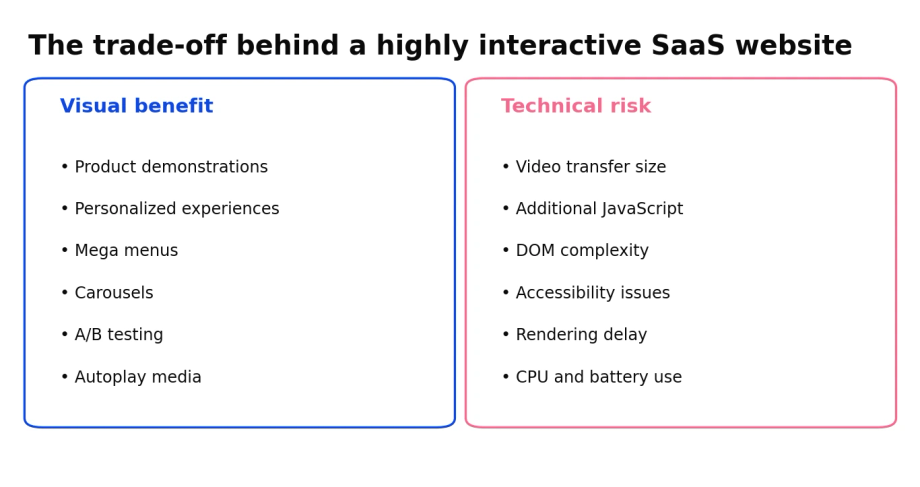
Several audited pages used full-page anti-flicker logic that could hide content for up to four seconds. The Learning and Development page also loaded multiple third-party experimentation scripts.
*Anti-flicker logic temporarily hides a page or part of it while an A/B testing variation loads, preventing visitors from briefly seeing the original version before it changes.
Priority improvements include restricting anti-flicker effects to tested components, lazy-loading secondary media, pausing offscreen videos, removing unused or overlapping third-party scripts, retaining captions, and avoiding multiple experimentation tools where one is sufficient.
11. International SEO: Hreflang, Localized URLs and Language Navigation
Language Selector and Localized Site Versions
Synthesia exposes localized versions for English, French, German, Spanish, and Brazilian Portuguese. The audited pages commonly included localized hreflang alternatives and translated URL structures.
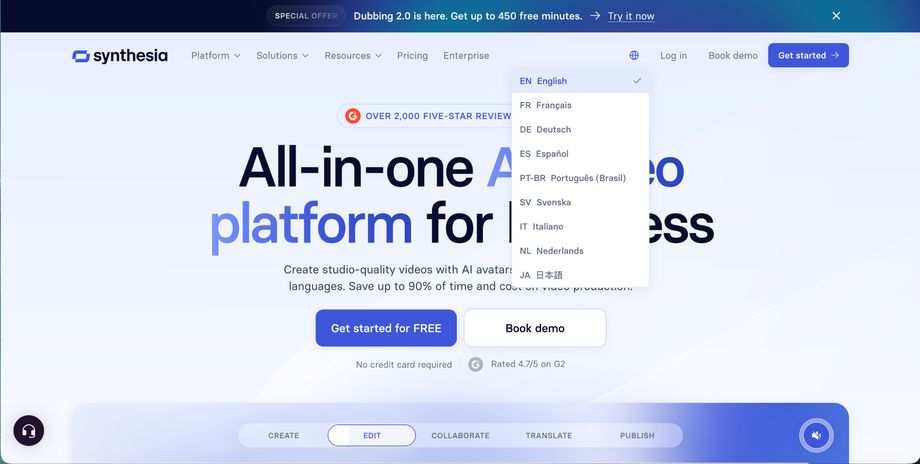
The main technical inconsistency is the English homepage reference using https://www.synthesia.io/?r=0 instead of the clean root URL. Internal links and hreflang should point directly to https://www.synthesia.io/.
12. Synthesia SEO Benchmark Scorecard
SEO Performance by Benchmark Area
The scorecard below summarizes Synthesia’s strongest SEO characteristics and the areas where the sampled pages reveal the greatest room for improvement.
| SEO benchmark area | Score | Assessment |
|---|---|---|
| Site architecture | 9/10 | Clear separation between features, teams, use cases, industries, resources, and trust content. |
| Navigation and discoverability | 9/10 | Workflow-based mega menus expose the main commercial and informational sections effectively. |
| Search-intent coverage | 9/10 | The site addresses capability-led, audience-led, use-case, industry, and educational searches. |
| Customer proof | 9/10 | Named customers, measurable outcomes, testimonials, and case studies support commercial claims. |
| Trust integration | 9/10 | Security, governance, responsible AI, and compliance signals are integrated into product discovery. |
| International SEO structure | 8/10 | Localized directories and hreflang are present, although the English homepage uses an unnecessary parameterized URL. |
| Internal-link precision | 7/10 | Global discoverability is strong, but contextual relationships between parent and child pages could be clearer. |
| Template consistency | 6/10 | Copied metadata, incorrect topic references, heading errors, and terminology inconsistencies appear across templates. |
| Claim governance | 6/10 | Quantitative proof is persuasive, but language, review, and product metrics are not always consistent across the site. |
| Technical efficiency | 5/10 | Rich media, multiple experimentation tools, anti-flicker logic, and JavaScript complexity create performance risks. |
Table 3. Synthesia SEO benchmark scorecard based on the sampled crawl and manual page reviews. These scores are editorial assessments, not direct measurements of organic traffic or ranking performance.
13. Key SaaS SEO Lessons from the Synthesia Benchmark
Synthesia’s strongest SEO lesson is not simply that SaaS websites need more landing pages. It is that one product can be expressed through multiple legitimate search dimensions:
- What the product does
- Who uses it
- What they use it for
- Where they use it
- Why they should trust it
This creates a powerful framework: Features → Teams → Use cases → Industries → Proof → Conversion.
But breadth alone is not enough. As the site grows, SEO becomes a governance discipline involving keyword ownership, template variables, product terminology, quantitative claims, internal-link relationships, structured data, localized equivalents, and technical dependencies.
Scalable SaaS SEO requires architectural breadth, but sustainable growth depends on editorial and technical precision.
14. Synthesia SEO Benchmark Frequently Asked Questions
It combines feature, team, use-case, industry, resource, trust, and conversion pages within one clearly visible commercial architecture.
Several pages target closely related training queries. Each URL therefore needs clear keyword ownership, distinctive examples, and a separate funnel role.
Its strongest asset is the way it translates one platform into multiple search entry points based on product capability, audience, specific use case, and industry.
The combination of rich media, multiple third-party experimentation scripts, and full-page anti-flicker logic creates the clearest technical performance risk in the sampled pages.