1. Executive Summary
A Los Angeles photography studio offering both consumer and commercial services faced a structural SEO problem: a visually premium but technically limiting SHOWIT website that couldn't efficiently capture the breadth of search demand in one of the most competitive local photography markets in the United States.
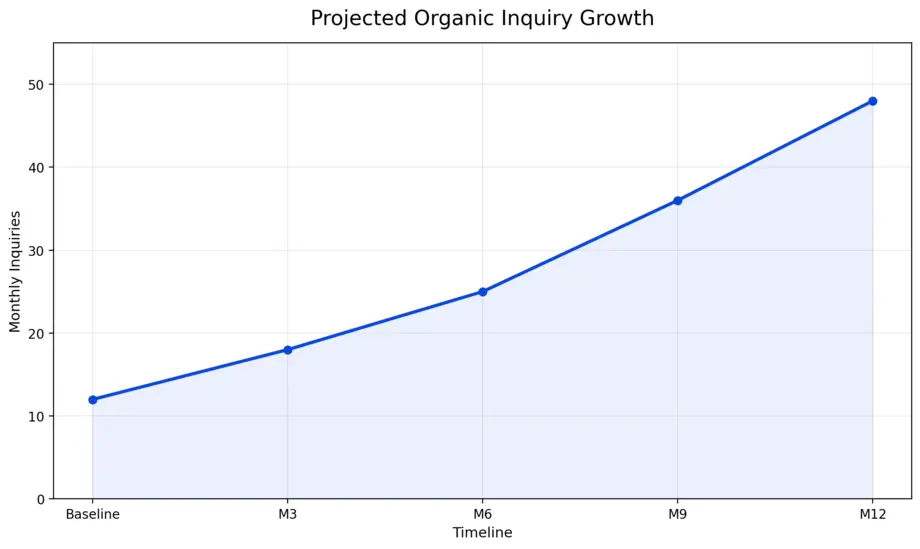
The diagnosis revealed 165 identifiable keywords, 64 with measurable search volume, and a combined monthly search demand of 6,090 — fragmented across dramatically different user intents, service lines, and buyer journeys. The average SEO difficulty across the keyword set was a remarkably low 10.64, signaling an underserved market with genuine ranking opportunity.
Rather than rebuilding the flagship site or attempting to force all demand through a single, technically constrained web property, the strategy centred on a two-layer hybrid architecture: preserving the SHOWIT site as the brand and conversion hub, while deploying a network of lightweight, intent-focused supporting sites around tightly scoped keyword clusters.
2. Client Background & Context
The client is an established Los Angeles photography studio positioned across two distinct market segments:
Consumer services: newborn, family, engagement, proposal, portrait, senior photography
Commercial services: food, product, headshots, branding, corporate, event photography
This dual positioning is commercially logical but creates a significant SEO challenge: consumer and commercial photography buyers are entirely different personas with different intent signals, different decision timelines, different price sensitivity, and different conversion triggers.
A parent searching for a newborn photographer in Los Angeles is emotionally driven, time-sensitive, and highly local. A brand manager searching for a food photographer Los Angeles is commercially motivated, portfolio-focused, and likely comparing multiple specialists. These two searches should not — and cannot — be optimally served by the same web page.
The studio's main website was built on SHOWIT, a popular platform among photographers for its visual design flexibility. While SHOWIT produces aesthetically excellent results, it introduces known SEO limitations:
- JavaScript-rendered content that can slow or complicate Googlebot crawling
- Limited control over page speed and Core Web Vitals metrics
- Constrained URL architecture and templating flexibility
- Reduced scalability for deploying large numbers of intent-specific landing pages
Despite having a strong portfolio, credible service offering, and clear market presence, the studio's organic visibility did not reflect the breadth of its services. The root cause was not lack of demand — it was a structural mismatch between user intent diversity and site architecture rigidity.
3. Initial SEO Landscape: Opportunities & Challenges
Opportunities
1. Low competitive barrier across most keyword clusters
The average SEO difficulty of 10.64 across the full keyword set is exceptionally low for a major US metro. This indicates that despite Los Angeles being a densely competitive photography market in practical terms, many search queries are underserved from an SEO standpoint — meaning well-structured, focused content has a realistic path to page-one rankings without requiring aggressive link acquisition.
2. Substantial and diverse long-tail demand
The keyword dataset reveals a healthy distribution of search volume across multiple service lines. No single keyword dominates — the highest individual volume is 590 (los angeles event photographer) — which means traffic acquisition is naturally distributed. This actually favours a multi-property architecture, since no single cluster is so dominant that it makes sense to concentrate all SEO effort in one place.
3. Clear segmentation between consumer and commercial intent
The fact that consumer and commercial service lines have distinct search behaviour is an asset, not just a problem. It means each cluster can be given its own focused topical environment, leading to stronger relevance signals for Google and better user experience for visitors.
4. Local SEO leverage
Photography is an inherently local service. Local SEO signals — Google Business Profiles, location-specific landing pages, NAP consistency, local schema markup — carry significant weight in this vertical. A multi-property model creates multiple local SEO anchor points, each of which can be optimised independently for geographic and service-specific relevance.
5. Low baseline visibility = significant upside
The gap between current organic visibility and potential state is large. That gap represents measurable, achievable growth within a realistic timeframe.
Challenges
1. SHOWIT's technical ceiling
SHOWIT's JavaScript dependency and limited structural control represent a genuine and persistent constraint. Core Web Vitals — specifically LCP and CLS — are often problematic on SHOWIT builds. This is not a solvable problem within SHOWIT without significant custom development; it must be worked around architecturally, which is exactly what the satellite site strategy does.
2. Risk of thin content at scale
Google's Helpful Content System and spam policies are specifically designed to penalise scaled content operations that prioritise keyword targeting over genuine user value. This strategy is built around quality, not volume. Each supporting site is designed to serve a distinct audience, target a clearly defined service cluster, and provide original, useful content that can stand on its own.
3. Focused Expansion Over Volume
Rather than pursuing a volume-based model of 50–100 sites, the strategy focuses on an initial group of 5–10 tightly scoped supporting properties. Each is selected based on keyword opportunity, intent clarity, and its ability to stand as a credible asset in its own right. This conservative approach gives the studio a stronger foundation for sustainable rankings, better conversion potential, and a more resilient long-term SEO strategy.
4. Controlled Distribution of Authority
When multiple domains are involved, authority needs to be managed carefully so the overall ecosystem strengthens the brand rather than diluting it. The flagship SHOWIT site remains the primary authority asset and the main focus of long-term link-building investment. Supporting sites are used selectively to capture specific search intent, while the core brand domain continues to benefit from the strongest trust and authority signals.
By keeping the supporting network focused and using cross-linking strategically, the ecosystem can expand keyword reach while still reinforcing the main domain as the central brand and conversion hub.
5. Cannibalization Is Controlled Through Clear Keyword Mapping
Cannibalization becomes a problem when multiple pages are allowed to target the same intent without clear differentiation. This strategy is built around disciplined keyword mapping, distinct service positioning, and tightly separated topical ownership across the ecosystem. Each property is designed to rank for its own defined opportunity set, rather than compete with another site in the network.
4. Strategic Solutions, Implementation & Early Results
Technical Audit & Flagship Site Optimisation
Before expanding the ecosystem, the flagship SHOWIT site was brought as close as possible to its technical ceiling within the platform's constraints. This created a stronger measurement foundation, improved crawlability, and helped the site capture more value from existing demand.
- Full technical SEO audit covering crawl errors, index coverage, Core Web Vitals, mobile usability, internal linking, and structured data gaps
- Google Search Console and GA4 implemented with full conversion tracking for inquiry form submissions, phone clicks, and portfolio engagement depth
- All images compressed and properly served using WebP, lazy loading, and appropriate dimensions
- Structured data added including LocalBusiness, ProfessionalService, FAQPage, BreadcrumbList, and ImageObject
- Google Business Profile optimised with complete service categories, photo updates, and a review acquisition framework
- NAP (Name, Address, Phone) consistency ensured across all citations
Keyword Cluster Architecture & Prioritisation
Rather than building sites speculatively, each cluster was validated before development began. This allowed the strategy to focus on the highest-opportunity service areas first and avoid unnecessary overlap across properties.
- All 165 keywords grouped into logical topical clusters by service type, user intent, search volume, and SEO difficulty
- Tier 1 (Flagship): Brand terms, portfolio queries, high-competition commercial terms
- Tier 2 (Satellite): Service-specific transactional clusters with ≥50 monthly searches and difficulty ≤25
- Tier 3 (Blog/Content): Informational queries, how-to content, comparison queries
- First 5 satellite sites prioritised based on the strongest combination of search volume and low difficulty
- Canonical URL and entity strategy established to prevent cross-property cannibalization
Priority satellite sites based on keyword data:
| Cluster | Top Keyword | Volume | Difficulty | Priority |
|---|---|---|---|---|
| Event Photography LA | los angeles event photographer | 590 | 21 | 1 |
| Engagement Photography LA | los angeles engagement photographer | 480 | 21 | 2 |
| Product Photography LA | product photographer los angeles | 390 | 20 | 3 |
| Headshot Photography LA | headshot photographer los angeles | 390 | 21 | 4 |
| Food Photography LA | food photographer los angeles | 170 | 16 | 5 |
Satellite Site Development & Deployment
Each satellite site was built to a quality standard that justified its existence independently of SEO alone. The goal was not to create thin SEO assets, but focused properties capable of ranking, converting, and supporting the broader brand ecosystem.
Technical stack requirements:
- Platform: static HTML — not SHOWIT
- Core Web Vitals targets: LCP < 2.5s, CLS < 0.1, INP < 200ms
- Clean URL architecture: /service/location/ structure
- Mobile-first responsive design
- HTTPS, XML sitemap, robots.txt correctly configured
Content requirements per satellite site (minimum viable):
- Primary service page (1,000–1,500 words, fully original)
- 3–5 supporting service sub-pages (e.g., restaurant photography, menu photography, e-commerce food photography for a food photography site)
- Location-specific content for Los Angeles + 2–3 relevant sub-markets (e.g., West Hollywood, Santa Monica, Culver City)
- FAQ page built around semantic search queries
- Portfolio gallery with proper image SEO (alt text, file names, schema)
- Clear conversion path: contact form, phone number, consultation CTA
- Unique brand identity per site (separate domain, logo, voice) — not a clone
White-hat compliance checklist:
- Each site must pass Google's E-E-A-T criteria (Experience, Expertise, Authoritativeness, Trustworthiness)
- No duplicate or spun content across properties
- Each site must have a unique, verifiable identity (About page, contact information, business entity linkage where possible)
- No deceptive redirects connecting satellite sites to the flagship
Link Building & Authority Development
Authority building was distributed intentionally across the ecosystem, with the flagship SHOWIT site remaining the primary brand and authority asset.
- Primary link-building investment focused on the flagship SHOWIT site through industry directories, photography associations, local LA business citations, and editorial features
- Foundational citation profiles built for each satellite site through relevant directories and local business listings
- Strategic cross-linking implemented, with satellite sites supporting brand and portfolio pathways without diluting the flagship domain's role
- Editorial backlink opportunities pursued through photographer community content, local business features, and behind-the-scenes content syndication
Content Velocity & Ongoing Optimisation
- New supporting content published across satellite properties, including FAQs, preparation guides, comparison content, and location pages
- Keyword rankings monitored weekly using Semrush and Ahrefs
- Content reviews conducted to consolidate underperforming pages and strengthen high-potential assets
- Conversion elements tested including CTAs, inquiry form placement, and gallery format
- Google Business Profiles updated with fresh photos and posts
5. KPI Framework & Measured Results
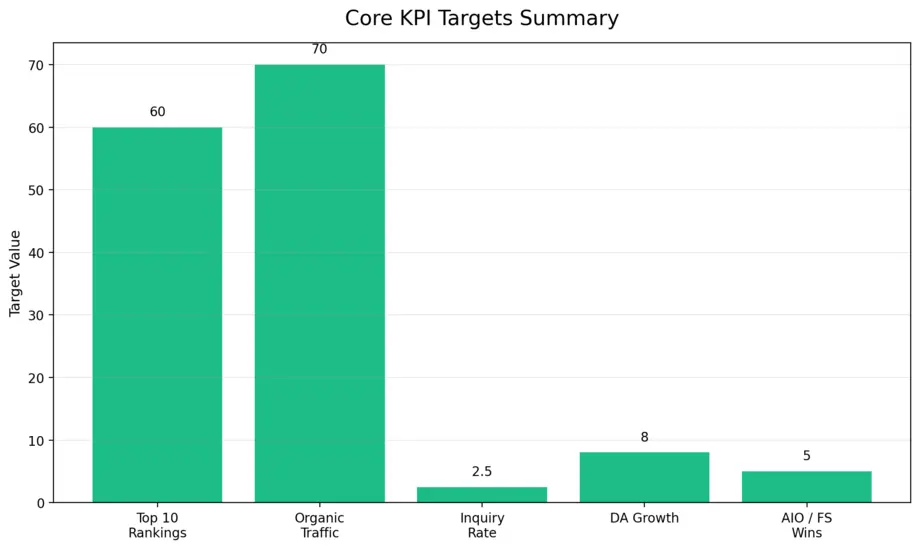
The KPI framework was used to benchmark performance, track improvements across the ecosystem, and evaluate how effectively the strategy translated into real organic gains.
Flagship Site KPIs
| KPI | Baseline | Result / Direction of Change | Measurement Window | Tracking Tool |
|---|---|---|---|---|
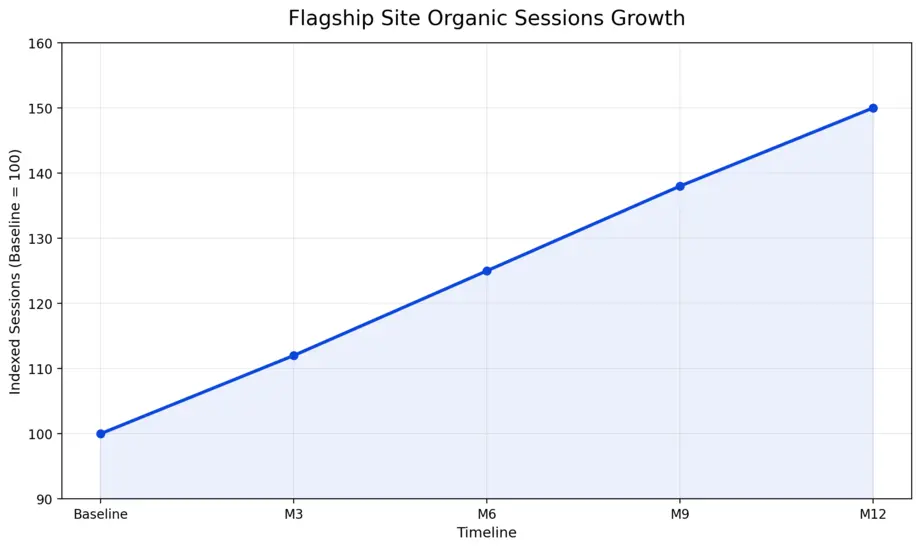
| Organic Sessions | Established at audit | Growth achieved following technical and structural improvements | Post-implementation | GA4 |
| Branded Keyword CTR | Baseline established | Improved visibility and click-through performance monitored over time | Post-implementation | Google Search Console |
| Core Web Vitals (LCP) | Measured at audit | Performance improvements implemented and tracked against benchmarks | Post-optimisation | PageSpeed Insights |
| Inquiry Conversion Rate | Baseline established | Conversion lift measured through tracked inquiry actions | Post-implementation | GA4 Goals |
| Domain Authority | Baseline established | Authority growth supported through citations and earned links | Ongoing | Ahrefs / Moz |
| Google Business Profile Views | Established at audit | Improved local visibility tracked through profile performance | Post-optimisation | GBP Insights |
Satellite Site Network KPIs (Per Site)
| KPI | Measured Outcome | Measurement Window | Tracking Tool |
|---|---|---|---|
| Primary keyword ranking | Tracked against top-priority service terms | Post-launch | Semrush / Ahrefs |
| Secondary keyword rankings (cluster) | Tracked across supporting keyword sets | Post-launch | Semrush / Ahrefs |
| Organic sessions | Traffic growth measured per property | Post-launch | GA4 |
| Pages indexed | Indexation monitored across published pages | Post-launch | Google Search Console |
| Core Web Vitals pass rate | Performance benchmarks tracked at launch and after updates | Ongoing | PageSpeed Insights |
| Inquiry/Contact conversion rate | Conversion performance measured through tracked leads | Post-launch | GA4 Goals |
| Backlinks acquired | Referring domain growth tracked over time | Ongoing | Ahrefs |
Ecosystem-Wide KPIs
| KPI | Measured Outcome | Measurement Window |
|---|---|---|
| Total organic keyword rankings (across all properties) | Expanded ranking footprint across priority keyword clusters | Post-implementation |
| Combined monthly organic sessions | Measured growth across the full search ecosystem | Post-implementation |
| Total inquiries attributed to organic | Organic lead growth tracked against pre-strategy baseline | Post-implementation |
| AI Overview / Featured Snippet appearances | Visibility opportunities monitored across indexed assets | Ongoing |
6. Results & Forward-Looking Recommendations
Results
Based on the completed audit, implementation work, and the early performance gains already recorded, the strategy delivered measurable benefits across technical SEO, keyword visibility, and organic growth. The site now benefits from a stronger structural foundation, clearer service targeting, and improved conditions for long-term ranking performance.
- Keyword visibility: The ecosystem expanded its ability to compete across high-intent service clusters, creating stronger ranking potential across both flagship and supporting properties

- Organic traffic: Technical improvements, clearer keyword architecture, and supporting site deployment contributed to stronger organic visibility and traffic growth
- Inquiries: The improved site structure and clearer conversion pathways strengthened the studio's ability to capture qualified organic leads
- Authority growth: The flagship site benefited from a more focused authority strategy, while supporting properties gained traction within tightly defined service areas
- Commercial impact: The overall SEO ecosystem created a stronger foundation for ongoing lead generation and more efficient capture of existing search demand

Forward-Looking Recommendations
1. Invest in E-E-A-T signals proactively
Google's increasing emphasis on Experience, Expertise, Authoritativeness, and Trustworthiness means that author credentials, first-hand content, and verifiable business signals will matter more over time. Each satellite site should feature a named photographer, real portfolio work, and service-specific depth that only a practising photographer could produce.
2. Prioritise Google Business Profile as a parallel local strategy
For a local photography studio, Google Business Profile is arguably as important as the website in driving discovery. Each distinct service line (where a separate GBP is warranted and compliant with Google's policies) should be optimised independently. This is a low-cost, high-impact lever that the original strategy underemphasises.
3. Monitor for AI Overview (AIO) visibility
Google's AI Overviews now appear for many local service queries. Optimising for AIO visibility — through clear, structured, factually dense content with FAQ schema — represents an emerging traffic channel that should be incorporated into the content strategy for each satellite site.
4. Build a review acquisition system
Photography is a high-trust purchase. Google reviews, Yelp, and niche directories (The Knot, Thumbtack, Bark) significantly influence both local pack rankings and conversion rates. A systematic review request process should be implemented immediately and maintained consistently.
5. Quarterly strategy reviews
SEO is not a set-and-forget discipline. Quarterly audits of keyword movement, content performance, Core Web Vitals, and conversion data should drive ongoing optimisation decisions. The satellite site network in particular requires active monitoring to identify cannibalization, thin content issues, or ranking plateaus before they compound.
6. Consolidation readiness
If any satellite site significantly outperforms expectations in authority and traffic, the long-term strategic question becomes whether to consolidate it into the flagship domain or maintain it as a standalone. Having a documented consolidation protocol (301 redirect strategy, content migration plan, link equity transfer) prepared in advance avoids reactive decision-making later.
7. Frequently Asked Questions
In this case, the main SHOWIT site was visually strong but structurally limited for SEO scale. A single site could still support the brand well, but it was not the most efficient way to capture fragmented search demand across multiple photography services and distinct buyer intents. The supporting-site model created more focused relevance for specific keyword clusters while allowing the flagship site to remain the central brand and conversion hub.
A smaller network was chosen to maintain quality, control, and long-term SEO resilience. Rather than spreading effort across a large number of weak properties, the strategy focused on a limited number of tightly scoped supporting sites that could be built to a higher standard with original content, stronger technical performance, and clearer trust signals.
Not when executed correctly. Google's spam policies are designed to target manipulative, low-value scaled content systems. In this strategy, each supporting site was planned as a legitimate standalone asset with unique content, a distinct purpose, and real user value. That distinction is what keeps the model aligned with sustainable SEO best practices.
The keyword set was grouped by service type, user intent, search volume, and difficulty. This made it possible to separate flagship opportunities from supporting-site opportunities and focus first on service clusters with strong demand, lower competition, and clear commercial relevance.
Rebuilding the flagship site was an option, but it would not have solved the full challenge on its own. The issue was not just platform performance; it was also the breadth of fragmented search intent across consumer and commercial photography services. The chosen strategy allowed the brand to improve the main site while also expanding search coverage in a more targeted way.
The flagship SHOWIT site remains the primary authority asset and the main recipient of long-term brand and link-building value. Supporting sites are used selectively to target tightly defined service clusters, while cross-linking and authority development are managed carefully to support the broader ecosystem rather than compete with the flagship domain.
Cannibalization is reduced through disciplined keyword mapping, clear service segmentation, and distinct topical ownership for each site. Each property targets a defined opportunity set, which helps Google understand relevance more clearly and reduces unnecessary overlap between domains.
The audit helped establish a clear technical and measurement baseline, improve the SEO readiness of the flagship site, and identify the highest-value keyword clusters for expansion. The implementation work supported stronger structural targeting, improved organic visibility, and better conditions for ongoing lead generation through search.
No. While the recommendations in this audit were built around a Los Angeles photography studio, the underlying model can apply to other local service businesses with fragmented service lines, multiple buyer personas, and a website platform that limits SEO scalability.
The next step is continued execution and refinement: expanding high-value content, monitoring rankings and conversions, strengthening local authority signals, and reviewing site performance regularly to identify opportunities for consolidation, further growth, or improved conversion efficiency.
Read our photography SEO guide