1. Executive Summary
A small architectural studio came to AskSEOCoach after discovering technical SEO issues during a website review.
The studio had recently redesigned its website to better showcase residential architecture projects, renovation services, and design consultations. Visually, the site looked professional. But after launch, organic traffic became unstable, several important pages were not gaining visibility, and the team noticed warnings in Google Search Console.
The business owner and marketing assistant had exported crawl reports, but the data felt overwhelming. They saw errors about redirects, canonical tags, missing titles, duplicate descriptions, image size, broken internal links, and sitemap inconsistencies — but they did not know which issues were serious and which were secondary.
They needed more than a technical audit. They needed someone to explain the problems clearly, prioritize the fixes, and help them communicate with their web developer.
AskSEOCoach coached the team through a structured technical SEO cleanup focused on crawlability, indexation, internal linking, and practical implementation.
| Business Type | Small Business |
|---|---|
| Industry | Architecture and Interior Design |
| Main Goal | Clean up technical SEO issues, improve crawlability and indexation, and create a simple technical SEO routine the team could maintain. |
| Target Market | London, United Kingdom |
2. Challenges
Crawl Reports Were Difficult to Interpret
The client had a crawl report showing more than 430 detected issues and warnings.
The problem was not that every issue was critical. The problem was that the team could not tell the difference between a real SEO blocker and a low-priority tool warning.
The crawl included:
- Broken internal links
- Redirect chains
- Duplicate title tags
- Missing meta descriptions
- Canonical inconsistencies
- Large image files
- Pages missing H1 tags
- Internal links pointing to redirected URLs
- Sitemap URLs that were not canonical
- Old staging URLs still referenced in the site
The team needed guidance to understand what mattered most.
Important Pages Were Not Properly Supported
Several important service pages were technically indexable, but not well connected internally.
Pages such as “residential architecture London,” “house extension architect,” “loft conversion architect,” and “interior design consultation” had very few internal links pointing to them.
Some blog posts and project pages linked to old URLs that redirected to the new versions. This weakened the internal linking structure and created unnecessary crawl inefficiency.
Sitemap and Canonical Problems
The XML sitemap contained outdated URLs, redirected pages, and a few pages that were no longer supposed to be indexed.
Some pages had canonical tags pointing to the correct URL, but the sitemap still included old or duplicate versions.
This created mixed signals for search engines and made it harder for the client to understand which pages Google should prioritize.
Website Migration Left Technical Debt
The redesign had changed several URLs. Redirects existed, but they were not always clean.
AskSEOCoach identified multiple redirect chains, including some URLs that passed through two or three steps before reaching the final page.
There were also internal links still pointing to old URLs instead of the final canonical versions.
Communication Gap With the Developer
The client had a developer, but the team did not know how to explain SEO issues clearly.
They needed developer-ready instructions with examples, priority levels, and validation steps.
Without this structure, technical SEO fixes risked being delayed or implemented incorrectly.
3. AskSEOCoach Approach
Guided Technical SEO Review
AskSEOCoach started with a coaching session dedicated to explaining the crawl report in simple terms.
The goal was to remove confusion and classify issues by real SEO impact.
The technical findings were grouped into four priority levels:
- Critical crawl and indexation issues
- Important internal linking and redirect issues
- On-page technical improvements
- Low-priority warnings to monitor later
This helped the client stop treating every warning as an emergency.
Crawlability and Indexation Cleanup
AskSEOCoach reviewed which pages should be indexed and which pages should not.
The cleanup focused on:
- Removing redirected URLs from the sitemap
- Excluding duplicate or low-value URLs
- Confirming canonical tags on service pages
- Checking that priority pages were indexable
- Reviewing Google Search Console indexing reports
- Making sure project pages did not create unnecessary duplication
This gave the site a cleaner indexation structure.
Redirect and Internal Link Fixes
AskSEOCoach helped the client identify and prioritize redirect problems.
The team found 47 internal links pointing to redirected URLs and 12 redirect chains left from the redesign.
Instead of relying only on redirects, the developer was instructed to update internal links directly to the final destination URLs.
This helped reduce crawl waste and created a cleaner internal linking structure.
Service Page Internal Linking Strategy
The technical cleanup was connected to business priorities.
AskSEOCoach helped the client identify which service pages needed more internal support.
Priority pages included:
- Residential architect London
- House extension architect London
- Loft conversion architect London
- Kitchen extension architect
- Interior design consultation
- Planning permission drawings
Internal links were added from relevant project case studies, blog articles, homepage sections, and service overview pages.
This made the site easier to crawl and helped users discover the most valuable commercial pages.
Metadata and Heading Cleanup
AskSEOCoach guided the team through fixing on-page technical issues that affected clarity.
The work included:
- Rewriting duplicate title tags
- Adding missing meta descriptions
- Fixing missing H1 tags
- Aligning headings with service intent
- Improving image alt text on project pages
- Reducing overly long title tags
- Clarifying page topics for search engines
The goal was to improve technical clarity without making the website feel over-optimized.
Image and Performance Guidance
Because the site was image-heavy, large project photos were slowing down several pages.
AskSEOCoach identified oversized image files and coached the team on a simple image optimization process.
The improvements included:
- Compressing large project images
- Using WebP where possible
- Adding width and height attributes
- Improving lazy loading
- Avoiding unnecessary full-size image uploads
- Prioritizing visual quality without harming page speed
This was especially important for mobile users browsing project galleries.
Developer-Ready SEO Task List
AskSEOCoach translated the audit into a clear developer task list.
Each task included:
- Issue description
- Priority level
- Example URLs
- Recommended fix
- SEO reason
- Validation method
This helped the client communicate with the developer more efficiently and reduced misunderstandings.
4. Results and Performance Metrics
1. Technical Issues Reduced Significantly
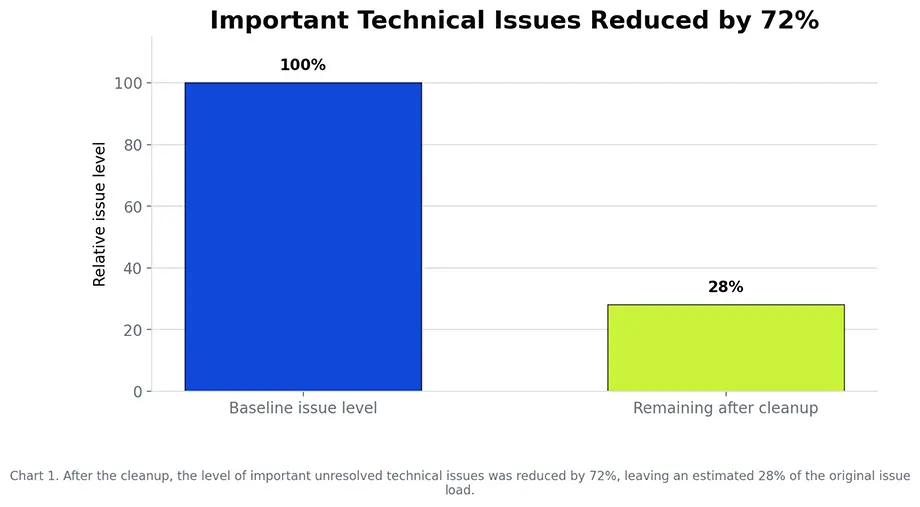
The initial crawl showed more than 430 issues and warnings.
After the cleanup, the number of important unresolved issues was reduced by 72%.
The biggest improvements included:
- Broken internal links reduced from 39 to 3
- Redirect chains reduced from 12 to 1
- Internal links to redirected URLs reduced from 47 to 5
- Duplicate title tags reduced from 28 to 6
- Sitemap errors reduced from 17 to 0
- Missing H1 tags reduced from 14 to 2
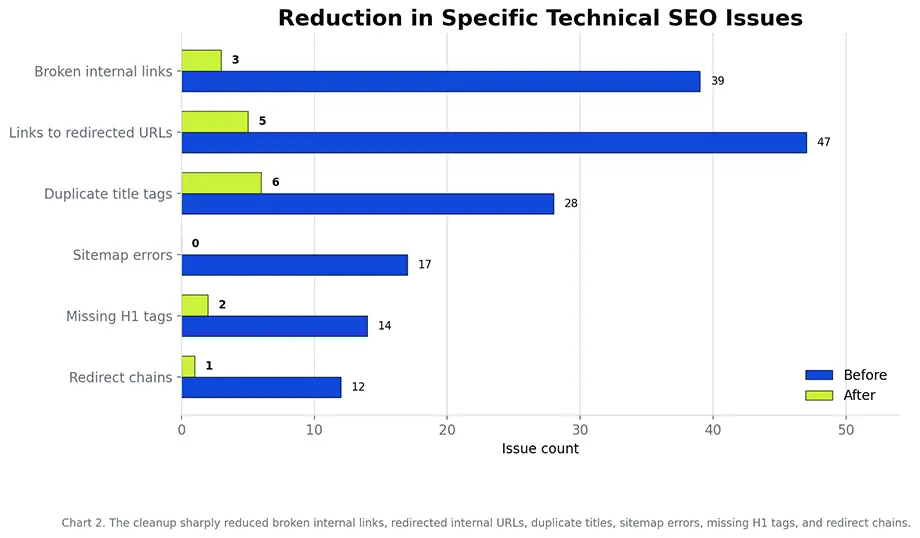
This gave the website a much cleaner technical foundation.
2. Cleaner Indexation Signals
The sitemap was rebuilt to include only canonical, indexable URLs.
Before the cleanup, the sitemap contained 23 problematic URLs , including redirected, duplicate, and outdated pages.
After the cleanup, the sitemap included only the intended priority URLs.
Google Search Console indexing reports became easier to interpret, and the client could more clearly distinguish real indexation issues from legacy migration noise.
3. Improved Crawl Efficiency
By fixing redirect chains and internal links to old URLs, the site became easier for search engines to crawl.
The number of crawlable HTML URLs in the site architecture was reduced from 186 to 154 , mainly by removing unnecessary legacy URLs, duplicate pages, and outdated project URLs.
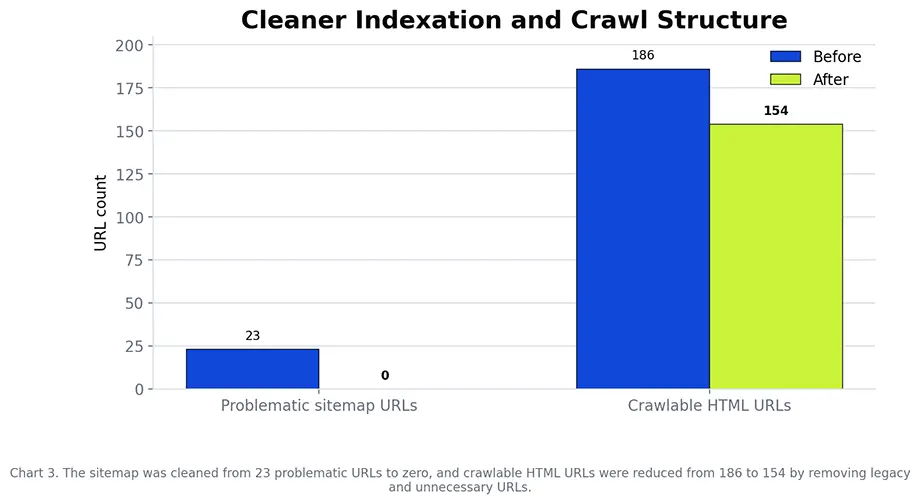
This helped focus crawl paths toward active service pages, project pages, and useful editorial content.
4. Stronger Internal Linking to Service Pages
AskSEOCoach helped the client add or correct 64 internal links to priority service pages.
The most important commercial pages received more contextual links from relevant project pages and blog content.
For example:
- The house extension service page gained 14 new internal links
- The loft conversion architect page gained 9 new internal links
- The residential architect London page gained 12 new internal links
- The planning permission drawings page gained 7 new internal links
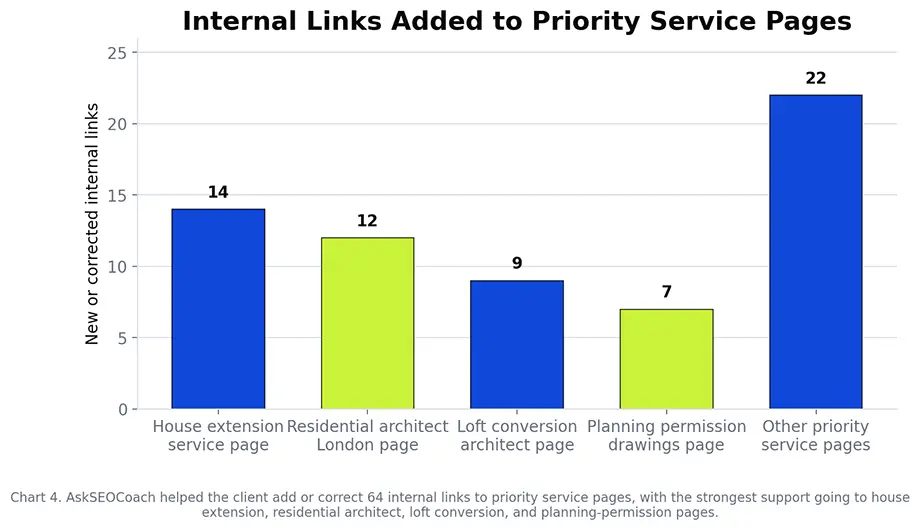
This helped strengthen the relationship between project examples and commercial services.
5. Better Organic Visibility for Priority Pages
After the technical cleanup and internal linking improvements, priority service pages began to show stronger visibility.
Tracked keyword improvements included:
- “residential architect London” improved from position 31 to 14
- “house extension architect London” improved from position 26 to 9
- “loft conversion architect London” improved from position 34 to 16
- “planning permission drawings London” improved from position 29 to 11
- “kitchen extension architect” improved from position 42 to 18

The strongest ranking gains came from pages that received both technical fixes and stronger internal links.
6. Organic Traffic and Lead Improvements
The technical cleanup helped stabilize organic traffic after the redesign.
Over the comparison period:
- Organic clicks to priority service pages increased by 38%
- Organic impressions for service pages increased by 81%
- Organic enquiries from service pages increased by 22%
- Average position across tracked service keywords improved from 32.7 to 18.4

The client also saw more users moving from project pages to service pages, which showed that the improved internal linking was helping both SEO and user navigation.
7. Completed SEO Actions
The project included 102 completed technical SEO actions .
Completed actions included:
- 17 sitemap and indexation fixes
- 12 redirect chain fixes
- 42 internal link corrections
- 22 new internal links added
- 18 metadata improvements
- 12 heading structure fixes
- 21 image optimization actions
- 5 structured data checks
- 3 Google Search Console validation checks
| Workstream | Completed actions |
|---|---|
| 17 sitemap and indexation | fixes |
| 12 redirect chain | fixes |
| 42 internal link | corrections |
| 22 new internal links | added |
| 18 metadata | improvements |
| 12 heading structure | fixes |
| 21 image optimization | actions |
| 5 structured data | checks |
| 3 Google Search Console validation | checks |
| Total completed technical SEO actions | 102 |
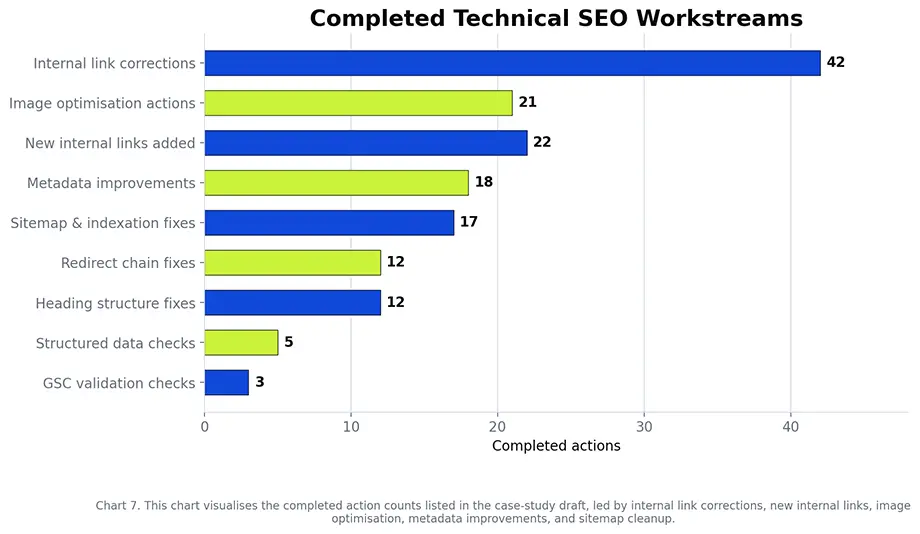
This gave the client a clear record of progress and a better understanding of how technical SEO actions support visibility.
5. Progress and Achievements
The architectural studio moved from technical confusion to technical control.
Before working with AskSEOCoach, the team had a crawl report full of warnings but no clear way to prioritize action.
After the coaching process, they had:
- A clean sitemap
- Fewer redirect issues
- Stronger internal links to service pages
- Better metadata and heading structure
- Improved image performance
- Clearer indexation signals
- A developer-ready SEO workflow
- A simple routine for future technical checks
The website became easier for search engines to crawl and easier for users to navigate.
6. What Made the Coaching Valuable
AskSEOCoach did not just deliver a technical audit. The client was coached through the meaning of each issue and guided through the cleanup process.
The team learned:
- Which technical SEO issues actually matter
- How to separate critical errors from minor warnings
- Why internal links should point to canonical URLs
- How sitemap and canonical signals work together
- How redirects affect crawl efficiency
- How to brief developers clearly
- How to monitor technical SEO without feeling overwhelmed
This made technical SEO more understandable and much easier to manage.
7. Outcome
Through dedicated technical SEO coaching, the architectural studio cleaned up the technical debt left by its redesign and created a stronger SEO foundation.
The site reduced important unresolved crawl issues by 72%, fixed sitemap errors completely, corrected or added 64 internal links to priority service pages, improved organic clicks to service pages by 38%, and increased organic enquiries from service pages by 22%.
Most importantly, the client gained the confidence and process needed to keep technical SEO under control after the coaching engagement.
What the Client Said
“Before working with AskSEOCoach, we had a technical SEO report full of errors and no idea where to start. The coaching helped us understand what mattered, explain fixes to our developer, clean up the website, and build a simple routine to prevent the same issues from coming back.”
8. Frequently Asked Questions
The team had a crawl report containing more than 430 issues and warnings, but it could not distinguish critical crawl and indexation problems from lower-priority tool warnings.
The first priorities were crawlability and indexation blockers, sitemap inconsistencies, redirect chains, broken internal links, internal links to redirected URLs, and weak support for important service pages.
Direct internal links to final canonical URLs reduce unnecessary redirect hops, improve crawl efficiency, and create a cleaner internal linking structure for users and search engines.
Redirected, duplicate, outdated, and non-indexable URLs were removed from the sitemap, while canonical tags and indexability were checked on priority service and project pages.
Priority service pages received stronger internal linking, cleaner crawl paths, improved metadata and headings, and clearer indexation signals, helping several commercial keywords move closer to page one.
The architecture website relied heavily on project photography. Compressing images, using WebP, adding dimensions, and improving lazy loading helped protect visual quality while reducing page-weight and performance problems.
Each task was translated into developer-ready instructions containing the issue, priority, example URLs, recommended fix, SEO reason, and validation method.
Important unresolved issues fell by 72%, sitemap errors were reduced from 17 to 0, 64 internal links were added or corrected, service-page clicks increased by 38%, and organic enquiries increased by 22%.
Yes. The same process can be adapted by separating critical issues from minor warnings, cleaning crawl and indexation signals, fixing internal links, supporting priority pages, and validating each implementation.
The team should continue monitoring crawl errors, sitemap quality, redirects, canonical tags, internal links, image performance, Search Console indexing reports, and visibility for priority service pages.
Continue exploring our SEO resources:
Technical SEO
Technical SEO Audit Checklist
How to perform a technical SEO Audit