1. Executive Summary
A B2B training company came to AskSEOCoach because its marketing team was responsible for SEO, but did not feel confident making strategic decisions.
The company offered professional training programs for managers, sales teams, HR departments, and customer service teams. The website had service pages, course pages, blog articles, downloadable resources, and landing pages, but SEO execution was inconsistent.
The team had access to Google Search Console, Google Analytics, keyword tools, and content optimization platforms. However, they often felt unsure about what the data meant. They could see rankings, impressions, clicks, and technical recommendations, but they struggled to translate that information into confident decisions.
They did not want a one-time audit that would sit in a folder. They wanted dedicated SEO coaching that would help the team understand SEO better, improve execution, and build a repeatable workflow.
AskSEOCoach worked with the marketing team through practical coaching sessions focused on keyword strategy, search intent, content optimization, internal linking, reporting, and decision-making.
| Business Type | B2B Company |
|---|---|
| Industry | Corporate Training and Professional Development |
| Main Goal | Help the marketing team build SEO confidence, improve organic visibility, and create a repeatable SEO workflow for course and resource pages. |
| Target Market | France |
2. Challenges
The Team Had SEO Tools but Lacked SEO Confidence
The marketing team had access to several SEO tools, but they were not always sure how to interpret the recommendations.
Some tools suggested adding keywords. Others flagged technical issues. Google Search Console showed impressions growing for some pages but clicks declining for others. The team often had too much information and not enough clarity.
Before coaching, the team described SEO as “something we know is important, but we are not always sure if we are doing it correctly.”
Course Pages Were Not Ranking for High-Intent Searches
The company had many course pages, but several important ones were not visible enough for commercial searches.
Before the coaching process, priority pages ranked outside the top 20 for keywords such as:
- management training course
- sales training for teams
- customer service training
- leadership training program
- HR training workshops
- workplace communication training
These pages were important because they were directly connected to lead generation and training enquiries.
Blog Content Was Educational but Not Strategic
The team had published many blog articles on workplace skills, leadership, communication, and productivity.
Some articles were useful, but they were not clearly connected to the company’s training offers. Blog posts often lacked internal links to course pages, and many articles targeted topics that were too broad or too disconnected from commercial priorities.
The blog was creating content activity, but not enough SEO value.
Inconsistent SEO Workflow
Each team member approached SEO differently.
Some pages had good titles but weak headings. Some blog posts had strong content but no internal links. Some landing pages had clear calls to action but poor keyword targeting.
The team needed a shared SEO process so everyone could work in the same direction.
Difficulty Explaining SEO Progress Internally
The marketing team also needed to report SEO progress to management.
However, the reports were either too detailed or too vague. Management wanted to know whether SEO was helping generate business opportunities, while the team mostly reported rankings, clicks, and content updates.
AskSEOCoach helped them connect SEO actions to business goals more clearly.
3. AskSEOCoach Approach
Dedicated SEO Coaching Program
AskSEOCoach created a coaching program based on recurring sessions, live page reviews, practical exercises, and implementation feedback.
The goal was not only to improve the website, but to improve the team’s ability to make SEO decisions independently.
The coaching program focused on five areas:
- Keyword and intent strategy
- Course page optimization
- Blog and resource content structure
- Internal linking
- SEO reporting and prioritization
Keyword and Search Intent Training
AskSEOCoach helped the team understand how to choose keywords based on intent, competition, business value, and page type.
Instead of targeting only high-volume keywords, the team learned to evaluate whether a query should be targeted with:
- A course page
- A service page
- A blog article
- A downloadable resource
- A comparison or guide page
- A FAQ section
This helped reduce confusion and improved the way the team planned content.
Course Page Optimization
AskSEOCoach reviewed the most important course pages with the team during live coaching sessions.
Together, they improved:
- Title tags
- Meta descriptions
- H1 and H2 structure
- Course descriptions
- Audience sections
- Learning outcomes
- FAQ blocks
- Internal links
- Calls to action
- Trust signals
- Schema markup opportunities
The goal was to make each course page clearer for users and more relevant for search engines.
Blog-to-Business Content Strategy
The blog was repositioned as a support system for commercial pages.
AskSEOCoach helped the team identify which articles should support which training offers.
For example:
- Articles about leadership mistakes were linked to leadership training pages
- Articles about handling difficult customers were linked to customer service training pages
- Articles about sales objections were linked to sales training pages
- Articles about workplace conflict were linked to communication training pages
- Articles about employee motivation were linked to management training pages
This helped connect informational content to commercial outcomes.
Internal Linking Coaching
The team was coached on how internal linking supports SEO architecture.
AskSEOCoach created a simple rule-based framework:
- Every new blog article should link to one relevant course page
- Every course page should link to related courses
- Every resource page should link to a commercial next step
- High-traffic articles should support high-value pages
- Internal links should use natural, descriptive anchor text
This made internal linking easier to apply consistently.
SEO Brief and Review Process
AskSEOCoach helped the team create a repeatable SEO brief template.
Each brief included:
- Target keyword
- Search intent
- Page type
- Funnel stage
- Target audience
- Suggested structure
- Internal links to add
- Existing pages to avoid duplicating
- Conversion goal
- Measurement metric
The team also introduced a pre-publication SEO review checklist so that new pages were more consistent before going live.
Reporting Dashboard and Monthly Review
AskSEOCoach simplified the team’s SEO reporting.
The new dashboard focused on:
- Priority keyword movement
- Organic clicks to course pages
- Organic enquiries
- Top improving pages
- Pages losing visibility
- Completed SEO actions
- Next month priorities
This helped the team report SEO progress in a way management could understand.
4. Results and Performance Metrics
1. Growth in Tracked Keyword Visibility
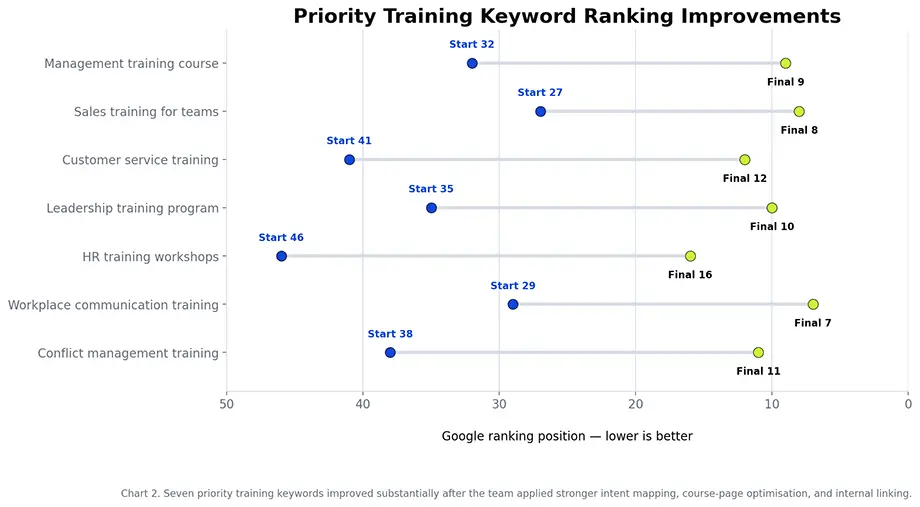
The website grew from 156 tracked ranking keywords to 487 tracked ranking keywords across the monitored keyword set.
The strongest growth came from commercial training terms, long-tail course searches, and resource-led queries.

Key ranking improvements included:
- “management training course” improved from position 32 to 9
- “sales training for teams” improved from position 27 to 8
- “customer service training” improved from position 41 to 12
- “leadership training program” improved from position 35 to 10
- “HR training workshops” improved from position 46 to 16
- “workplace communication training” improved from position 29 to 7
- “conflict management training” improved from position 38 to 11
The website also gained visibility for more specific long-tail searches connected to course formats, team training, and in-company workshops.
2. More Page-One Rankings for Commercial Pages
Before coaching, the company had 11 page-one rankings across its tracked keyword set.
After the coaching program and implementation cycle, the site reached 49 page-one rankings .
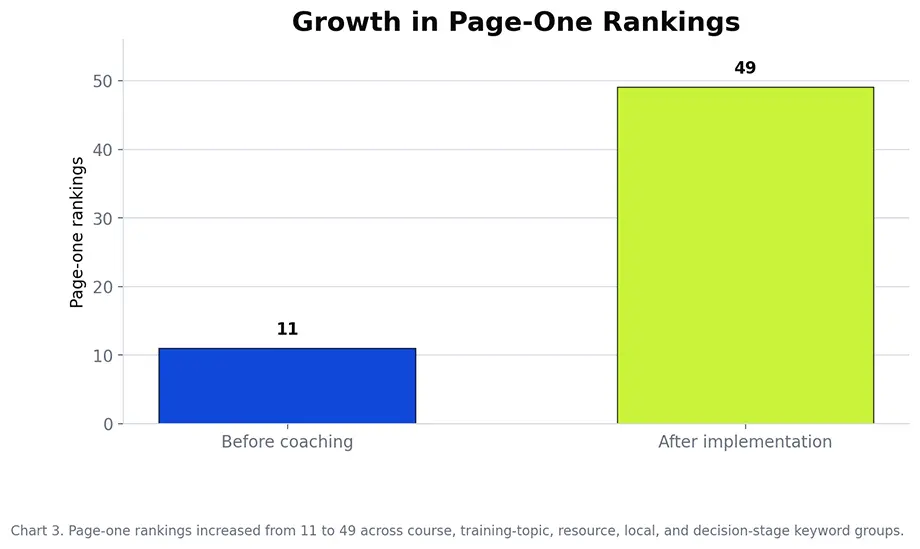
This included:
- 18 course-related keywords
- 13 training topic keywords
- 9 resource-based keywords
- 6 local or in-company training keywords
- 3 comparison or decision-stage keywords
This showed that SEO visibility was becoming more balanced across the buyer journey.
3. Improved Course Page Performance
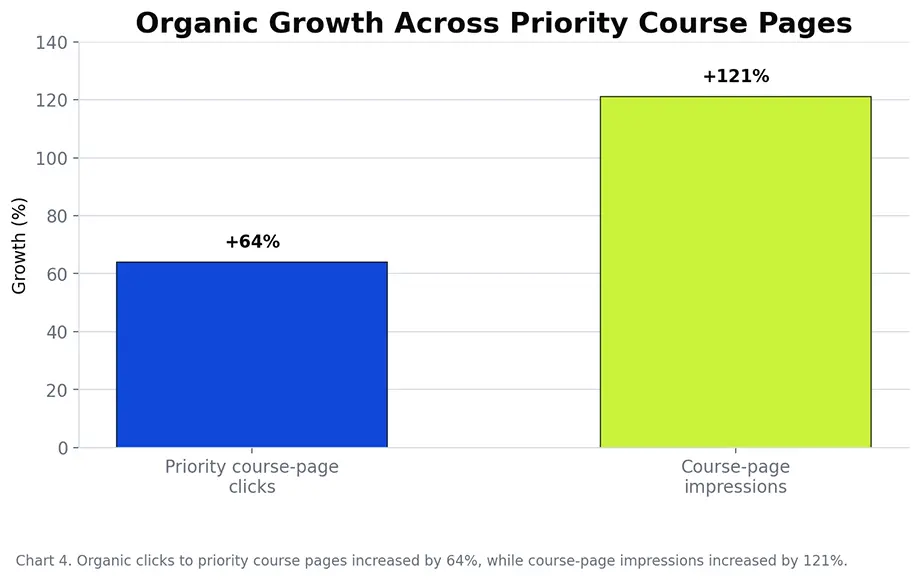
The optimized course pages showed strong progress.
Organic clicks to priority course pages increased by 64% .
Organic impressions for course pages increased by 121% .
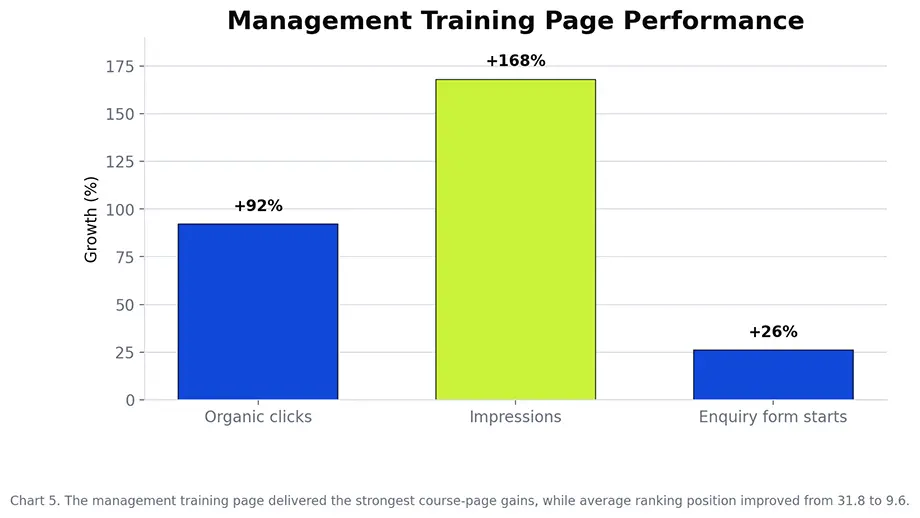
The management training page showed the strongest improvement:
- Organic clicks increased by 92%
- Impressions increased by 168%
- Average ranking position improved from 31.8 to 9.6
- Enquiry form starts from organic users increased by 26%
The sales training and workplace communication pages also gained stronger visibility after content improvements and internal links from related blog articles.
4. Blog Content Started Supporting Lead Generation
Before coaching, the blog generated traffic but did not strongly support business goals.
After the blog-to-business internal linking framework was implemented:
- Clicks from blog articles to course pages increased by 73%
- Organic users visiting at least one course page after reading a blog post increased by 41%
- CTA clicks from informational articles increased by 28%
- Resource downloads from organic traffic increased by 36%

This showed that the blog was no longer isolated from the commercial side of the website.
5. Better SEO Execution Across the Team
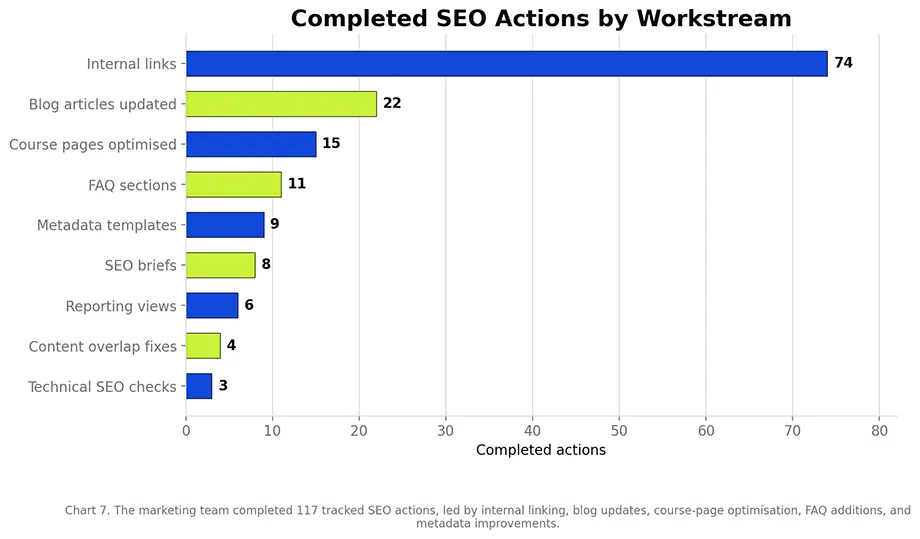
The marketing team completed 117 SEO actions during the coaching engagement.
Completed actions included:
- 15 course pages optimized
- 22 blog articles updated
- 8 new SEO briefs created
- 74 internal links added or corrected
- 11 FAQ sections added
- 9 metadata templates improved
- 6 reporting views simplified
- 4 content overlap issues resolved
- 3 technical SEO checks completed
The team also began using the SEO brief template for all new content, making future execution more consistent.
6. Organic Enquiry Growth
The company tracked training enquiries from organic traffic.
During the comparison period:
- Organic enquiries increased by 31%
- Organic-assisted leads increased by 24%
- Non-branded organic clicks increased by 52%
- Organic traffic to commercial pages increased by 58%

The results showed that stronger SEO confidence and better execution were contributing to business outcomes, not only rankings.
7. Stronger Internal Reporting
The marketing team moved from scattered SEO updates to a clearer monthly reporting format.
Instead of showing management a long list of rankings and tool screenshots, the team could now explain:
- Which course pages improved
- Which keywords moved into page one
- Which content updates were completed
- Which blog posts supported commercial pages
- Which pages needed more work
- How organic traffic contributed to enquiries
This improved internal confidence and made SEO easier to defend as a business channel.
5. Progress and Achievements
The biggest achievement was the team’s transformation.
Before working with AskSEOCoach, the marketing team had tools, content, and ambition — but lacked confidence and structure.
After the coaching process, the team had:
- A clearer understanding of keyword intent
- A stronger course page optimization process
- A blog strategy connected to business goals
- A repeatable SEO brief template
- A practical internal linking framework
- A simplified reporting dashboard
- More confidence in explaining SEO progress
- Better alignment between SEO work and lead generation
SEO became a shared team process instead of an uncertain task handled differently by each person.
6. What Made the Coaching Valuable
AskSEOCoach did not simply provide training videos or a generic audit. The coaching was based on the company’s real website, real pages, real keywords, and real business goals.
The team learned by working directly on their own SEO challenges.
They learned:
- How to choose keywords with business intent
- How to match keywords to the right page type
- How to optimize course pages properly
- How to connect blog content to commercial pages
- How to avoid creating disconnected content
- How to use internal links strategically
- How to report SEO progress clearly
- How to make decisions without relying blindly on tools
This helped the team become more autonomous and more confident.
7. Outcome
Through dedicated SEO coaching, the B2B training company improved both SEO performance and internal capability.
The site grew from 156 to 487 tracked ranking keywords , increased page-one rankings from 11 to 49 , improved organic clicks to priority course pages by 64% , and increased organic enquiries by 31% .
Most importantly, the marketing team gained a repeatable SEO process they could continue using independently.
What the Client Said
“Before working with AskSEOCoach, we had SEO tools and content, but we were not confident in our decisions. The coaching helped us understand search intent, improve our course pages, connect blog content to business goals, and report SEO progress clearly. We now know what to do and why we are doing it.”
8. Frequently Asked Questions
The team had access to SEO tools and data but lacked confidence in interpreting recommendations, prioritising actions, and connecting SEO work to business goals.
The program focused on keyword and search intent strategy, course-page optimisation, blog and resource structure, internal linking, SEO briefs, reporting, and prioritisation.
The team learned to decide whether a query should be targeted with a course page, service page, blog article, downloadable resource, comparison page, guide, or FAQ section.
Priority course pages were improved through stronger titles, metadata, headings, descriptions, audience sections, learning outcomes, FAQs, internal links, calls to action, trust signals, and schema opportunities.
Blog articles were connected to relevant course pages through contextual internal links, helping informational content guide users towards commercial next steps.
Every new blog article linked to a relevant course page, course pages linked to related courses, resource pages linked to a commercial next step, and high-traffic articles supported high-value pages.
Tracked ranking keywords increased from 156 to 487, page-one rankings from 11 to 49, clicks to priority course pages by 64%, and organic enquiries by 31%.
The management training page increased organic clicks by 92%, impressions by 168%, improved average position from 31.8 to 9.6, and increased enquiry form starts by 26%.
Yes. The framework can be adapted for in-house marketing teams that need a repeatable process for keyword selection, page optimisation, internal linking, content reviews, and reporting.
The team should continue using the SEO brief template, reviewing priority pages monthly, expanding successful course clusters, strengthening internal links, and connecting SEO performance to enquiries and leads.
Continue exploring our SEO resources:
SEO for Marketing Agencies