1. Executive Summary
A B2B SaaS company offering employee onboarding software came to AskSEOCoach with a strong product, an active blog, and a growing marketing team — but no clear SEO architecture.
The company had already published product pages, feature pages, comparison pages, and many blog articles. However, the website felt fragmented. Some content generated impressions, but not enough qualified traffic. Some pages ranked for informational keywords, but they did not support demo requests. Important commercial pages were not receiving enough internal links, and the team was unsure how to organise future content.
The client did not need “more content” immediately. It needed a clearer SEO system: better page roles, stronger topic clusters, improved internal linking, and a scalable process for creating content that supports business growth.
AskSEOCoach worked with the SaaS team through dedicated SEO coaching to turn scattered content into a structured SEO architecture.
| Business Type | B2B SaaS |
|---|---|
| Industry | HR Technology / Employee Onboarding Software |
| Main Goal | Build a scalable SEO architecture connecting informational content, product pages, comparison pages, and demo-driven landing pages. |
| Target Market | United States and United Kingdom |
2. Challenges
Scattered Content Without Clear Page Roles
The company had published more than 80 blog articles, but many of them were disconnected from the product journey.
Some articles answered useful HR questions, but they did not link to relevant feature pages or conversion pages. Other pages targeted similar topics, creating overlap between blog posts, templates, and product-led content.
The team could not clearly define which pages were supposed to attract awareness traffic, which pages were supposed to support consideration, and which pages were supposed to convert visitors into demo requests.
Weak Visibility for Commercial SaaS Keywords
The website had some visibility for informational searches, but it was weak for high-intent SaaS queries.
Before coaching, the site had limited rankings for keywords such as:
- employee onboarding software
- onboarding automation platform
- HR onboarding workflow software
- new hire onboarding checklist software
- employee onboarding tool for remote teams
- onboarding software for small business
Several commercial keywords ranked between positions 25 and 60, which generated impressions but very few qualified clicks.
Blog Traffic Was Not Supporting Conversions
The blog attracted some organic visits, but many users left after reading one article.
Internal linking was inconsistent, and there were not enough clear pathways from educational content to product pages, templates, feature pages, or demo calls to action.
The result was a classic SaaS SEO problem: content existed, but the content architecture did not guide users towards the product.
Keyword Cannibalisation and Topic Overlap
Several articles covered similar ideas around onboarding checklists, employee onboarding process, onboarding best practices, and remote onboarding.
Because the pages were not mapped clearly, Google sometimes rotated rankings between multiple similar URLs. This made performance unstable and diluted the authority of key pages.
No Repeatable SEO Brief Process
The marketing team produced content regularly, but briefs varied in quality. Some briefs included keywords and headings, while others lacked search intent analysis, internal link targets, funnel stage, or conversion goal.
The team needed a repeatable framework for planning and creating SEO content.
3. AskSEOCoach Approach
SEO Architecture Review
AskSEOCoach started with a complete review of the website structure, existing pages, keyword rankings, internal links, and content performance.
The goal was to understand how the site was currently organised and where the architecture was preventing growth.
The review identified four core page types:
- Product and feature pages
- Use-case pages
- Comparison pages
- Educational blog and template content
Each page type was assigned a clearer SEO role.
Search Intent and Funnel Mapping
AskSEOCoach helped the team map keywords by intent and funnel stage.
The structure separated:
- Awareness keywords, such as onboarding best practices and employee onboarding process
- Mid-funnel keywords, such as onboarding checklist template and remote onboarding workflow
- Commercial keywords, such as employee onboarding software and onboarding automation platform
- Comparison keywords, such as onboarding software alternatives and best HR onboarding tools
This helped the team stop treating all keywords the same way.
Each keyword was mapped to the correct page format: blog article, template page, use-case page, feature page, comparison page, or product landing page.
Topic Cluster Creation
AskSEOCoach helped the SaaS team build three main SEO clusters:
Cluster 1: Employee Onboarding Software
This cluster focused on commercial and product-led searches.
It included the main onboarding software page, feature pages, automation pages, and comparison content.
Cluster 2: Onboarding Checklists and Templates
This cluster focused on mid-funnel users looking for practical resources.
It included checklist pages, downloadable templates, workflow examples, and internal links towards the software solution.
Cluster 3: Remote and Hybrid Onboarding
This cluster focused on modern workplace onboarding challenges.
It included remote onboarding guides, distributed team workflows, compliance checklists, and relevant product use cases.
This cluster structure gave the website a stronger topical foundation and reduced content overlap.
Internal Linking Framework
AskSEOCoach created an internal linking model designed specifically for SaaS SEO.
The model included:
- Blog articles linking to relevant templates
- Templates linking to feature and product pages
- Feature pages linking back to supporting educational content
- Comparison pages linking to demo pages
- Use-case pages linking to product features
- High-traffic articles linking to high-value commercial URLs
This helped distribute authority more intentionally across the site and gave users a clearer path from education to conversion.
Content Consolidation and Cannibalisation Fixes
AskSEOCoach identified pages competing for similar keywords and guided the team through consolidation decisions.
Some articles were merged into stronger resources. Others were repositioned around more specific long-tail queries. A few low-value posts were redirected to better-performing pages.
This reduced keyword cannibalisation and helped Google understand which pages were the main authority for each topic.
SEO Brief Coaching
The marketing team was coached on how to create stronger SEO briefs.
Each new brief included:
- Primary keyword
- Secondary keyword group
- Search intent
- Funnel stage
- Recommended page type
- SERP analysis summary
- Suggested H2 structure
- Internal links to include
- Conversion goal
- Differentiation angle
- Existing pages to avoid duplicating
This gave writers and marketers a repeatable process for future content creation.
4. Results and Performance Metrics
1. Growth in Keyword Visibility
The website grew from 214 tracked ranking keywords to 612 tracked ranking keywords across the monitored keyword set.
The strongest growth came from commercial and mid-funnel SaaS queries connected to onboarding workflows, templates, and automation.

Key ranking improvements included:
- “employee onboarding software” improved from position 38 to 11
- “onboarding automation platform” improved from position 44 to 9
- “HR onboarding workflow software” improved from position 51 to 13
- “new hire onboarding checklist software” improved from position 29 to 7
- “remote employee onboarding tool” improved from position 46 to 12
- “onboarding checklist template” improved from position 18 to 5
- “employee onboarding process checklist” improved from position 23 to 8
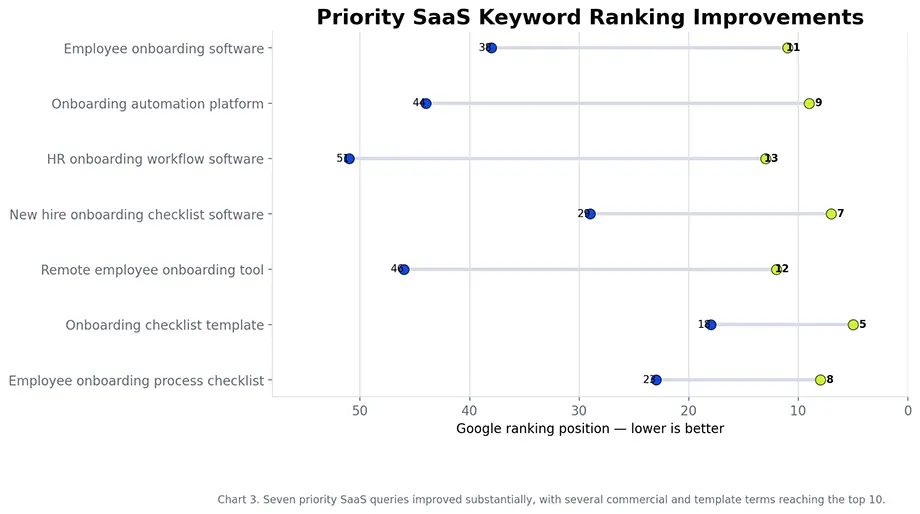
The improved rankings showed that the site was gaining visibility not only for broad educational content, but also for commercial and product-led searches.
2. More Page-One Rankings
Before the coaching engagement, the website had 17 page-one rankings across its tracked keyword set.
After the architecture and content improvements were implemented, the site reached 68 page-one rankings.
This included:
- 19 commercial or product-related keywords
- 27 template and checklist keywords
- 14 remote onboarding keywords
- 8 comparison or alternative keywords
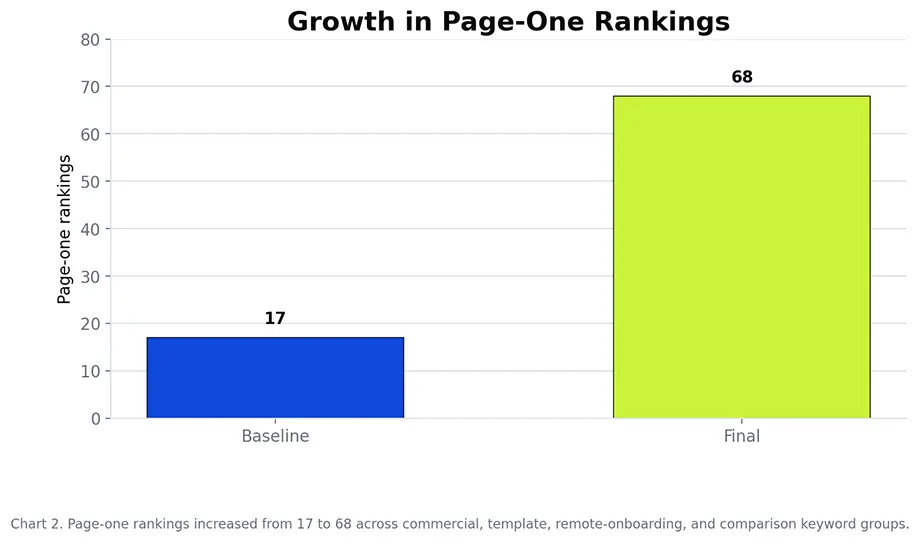
The increase in page-one rankings helped the SaaS company become visible across multiple stages of the buyer journey.
3. Stronger Performance of Commercial Pages
Commercial SaaS pages improved significantly after internal linking, content expansion, and better intent alignment.
Organic clicks to product and feature pages increased by 71%.
Organic impressions for commercial pages increased by 139%.
The main onboarding software landing page saw:
- +88% organic clicks
- +162% impressions
- Average ranking position improving from 34.8 to 13.2
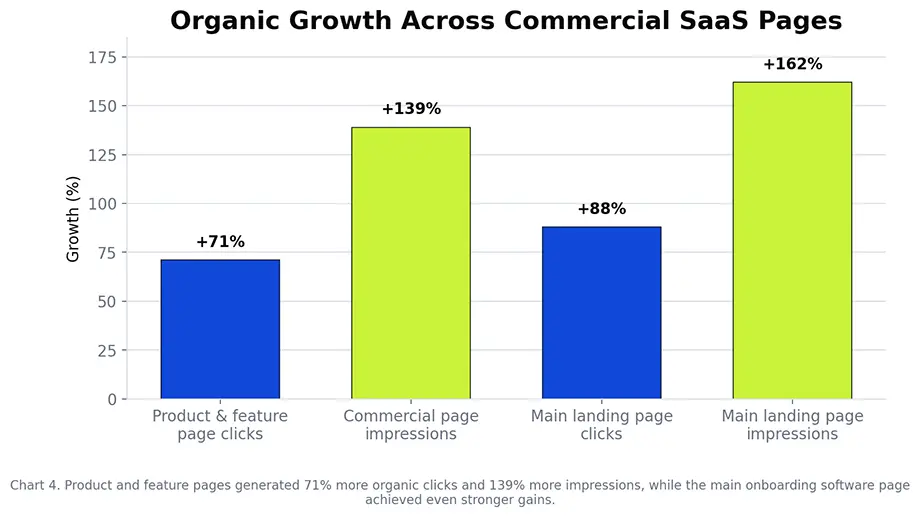
The onboarding automation feature page moved into the Top 10 for several high-intent queries after being rewritten and supported by internal links from related content.
4. Blog Traffic Became More Product-Connected
The blog did not only grow in traffic. It became more useful for the product journey.
Organic clicks to optimised blog and template content increased by 46%, but the more important improvement was behavioural.
After internal linking updates:
- Clicks from blog pages to product and feature pages increased by 58%
- Template page visits from blog content increased by 64%
- Demo CTA clicks from organic landing pages increased by 29%

This showed that SEO content was no longer isolated from business goals.
5. Reduction in Content Cannibalisation
AskSEOCoach identified 14 pages affected by topic overlap or keyword cannibalisation.
After consolidation and repositioning:
- 5 articles were merged into stronger guides
- 4 articles were redirected
- 3 articles were repositioned for more specific long-tail queries
- 2 pages were rewritten with clearer intent separation
Ranking volatility decreased across the affected keyword groups, and the main target pages gained more stable visibility.
6. SEO Pipeline and Conversion Impact
The client tracked demo-related actions from organic traffic.
During the comparison period:
- Organic demo requests increased by 32%
- Organic-assisted pipeline increased by 27%
- Non-branded organic traffic increased by 54%
- Organic landing page engagement improved, with more users visiting feature and use-case pages
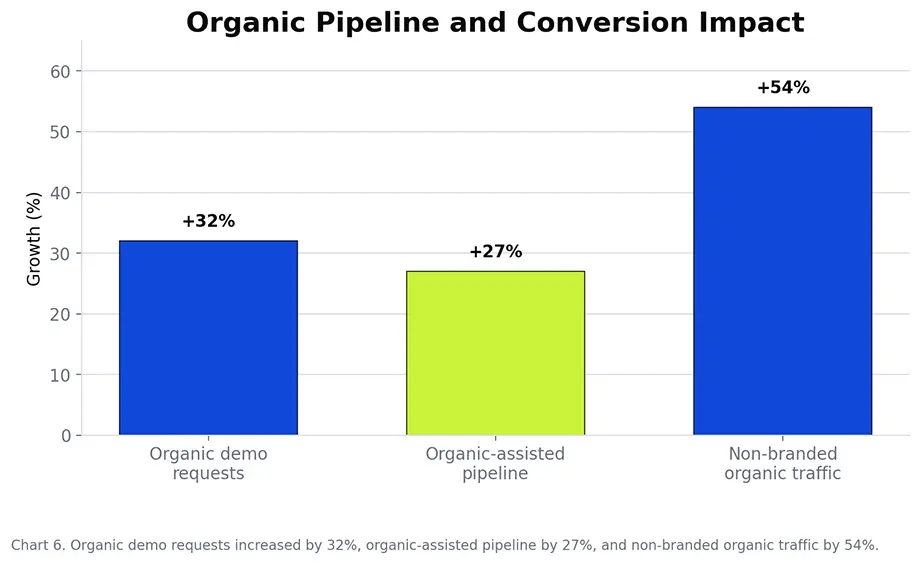
While SEO was not the only growth channel, the improved architecture helped organic traffic contribute more clearly to the sales funnel.
7. Completed SEO Actions
The project included 128 completed SEO actions.
Completed actions included:
- 11 product and feature pages optimised
- 9 template pages improved
- 24 blog articles updated
- 5 content consolidations completed
- 4 redirects implemented
- 63 internal links added or corrected
- 6 new SEO briefs created
- 3 comparison page outlines created
- 3 reporting views simplified
| Workstream | Completed actions |
|---|---|
| Product and feature pages optimised | 11 |
| Template pages improved | 9 |
| Blog articles updated | 24 |
| Content consolidations completed | 5 |
| Redirects implemented | 4 |
| Internal links added or corrected | 63 |
| New SEO briefs created | 6 |
| Comparison page outlines created | 3 |
| Reporting views simplified | 3 |
| Total | 128 |
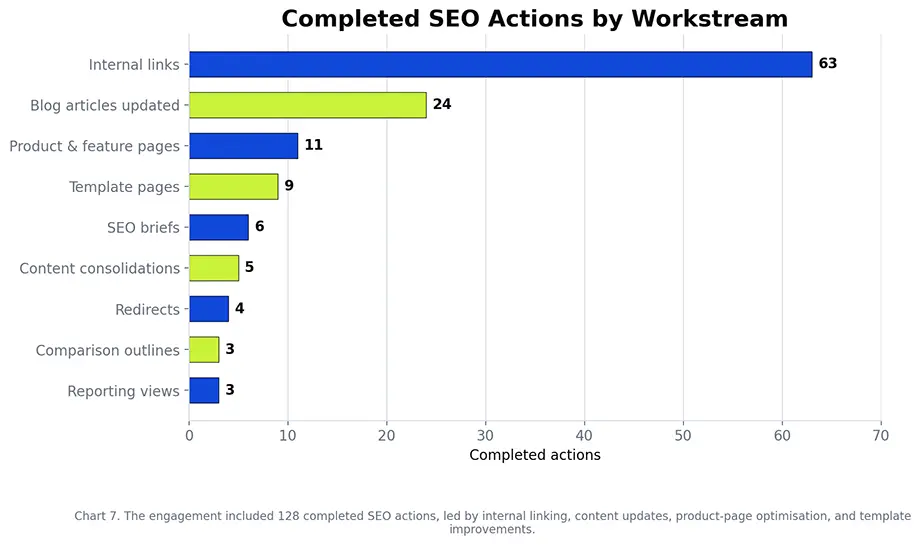
This gave the team a clear view of progress and helped it continue SEO execution after the coaching engagement.
5. Progress and Achievements
The SaaS team moved from scattered content production to a scalable SEO architecture.
Before working with AskSEOCoach, the company had a lot of content but no clear structure connecting that content to product growth.
After the coaching process, the team had:
- Clear page roles
- Stronger topic clusters
- Better keyword-to-page mapping
- Improved internal linking
- Reduced cannibalisation
- Stronger commercial page visibility
- A repeatable SEO brief process
- Better reporting around organic growth and demo impact
The website became easier for both search engines and users to understand.
6. What Made the Coaching Valuable
AskSEOCoach did not simply tell the team to “publish more content.” The coaching helped it understand how SaaS SEO architecture works.
The team learned:
- How to separate informational, mid-funnel, and commercial intent
- How to decide which page type a keyword needs
- How to build topic clusters around product value
- How to use internal links to support conversion pages
- How to identify and fix keyword cannibalisation
- How to create stronger SEO briefs
- How to connect SEO traffic to demo requests and pipeline
This gave the team better SEO judgement and a process it could scale internally.
7. Outcome
Through dedicated SEO coaching, the SaaS company transformed a fragmented content library into a structured SEO architecture.
The website grew from 214 to 612 tracked ranking keywords, increased page-one rankings from 17 to 68, improved organic clicks to product and feature pages by 71%, and increased organic demo requests by 32%.
Most importantly, the team gained a scalable SEO system that could guide future content, internal linking, and product-led SEO decisions.
What the Client Said
“Before working with AskSEOCoach, we had a lot of content, but it was not working together. The coaching helped us organise our pages, fix overlapping topics, improve internal linking, and connect SEO content to demo requests. We now have a structure the whole team can follow.”
8. Frequently Asked Questions
The website had many product pages, feature pages, templates, comparison pages, and blog articles, but they were not organised around clear search intents, funnel stages, or conversion goals.
The company already had more than 80 blog articles. The greater opportunity was to improve existing page roles, consolidate overlapping content, strengthen internal linking, and connect informational traffic to product and demo pages.
Keywords were classified by search intent and funnel stage, then assigned to the most suitable page type, such as a blog article, template, use-case page, feature page, comparison page, or product landing page.
The strategy created three main clusters around employee onboarding software, onboarding checklists and templates, and remote and hybrid onboarding.
Internal links connected blog articles to templates, templates to product and feature pages, use-case pages to relevant features, and comparison pages to demo-focused landing pages.
Overlapping pages were reviewed and either consolidated, redirected, repositioned around more specific long-tail queries, or rewritten with clearer search intent and page ownership.
Commercial pages received stronger internal links, clearer keyword targeting, expanded product-focused content, and better alignment with high-intent SaaS searches.
Yes. Blog-to-product clicks increased by 58%, visits from blog content to template pages increased by 64%, and demo CTA clicks from organic landing pages increased by 29%.
Tracked ranking keywords increased from 214 to 612, page-one rankings increased from 17 to 68, organic clicks to product and feature pages increased by 71%, and organic demo requests increased by 32%.
Yes. The framework can be adapted by defining clear page roles, mapping keywords by funnel stage, building product-led topic clusters, improving internal linking, reducing content overlap, and connecting SEO performance to demos and pipeline.
The next priorities should include expanding successful topic clusters, improving comparison and use-case pages, strengthening product-led content, monitoring cannibalisation, and measuring organic contributions to demos and pipeline.
Continue exploring our SEO resources for startups:
Guides:
SEO for Startups
SEO for AI Startups
SEO for SAAS Startups
SEO for TECH Startups
E-Books:
SEO for AI Startups Guide: Get Cited by Generative Engines
Website Architecture for AI Startups: Optimize Structure to Be Cited