1. Executive Summary
A digital publisher in the personal finance education space came to AskSEOCoach after several months of unstable organic traffic.
The site had hundreds of articles covering budgeting, savings, credit cards, debt management, mortgages, and beginner investing. Some articles had performed well for years, but traffic had become unpredictable. A few important guides were losing rankings, newer articles were not gaining visibility, and the editorial team was unsure whether the issue came from Google updates, stronger competitors, outdated content, weak expertise signals, or technical SEO problems.
The publisher did not need to rewrite everything. It needed a clearer system for understanding content performance, identifying priority pages, and deciding which articles to update, merge, redirect, or leave untouched.
AskSEOCoach supported the team through a dedicated SEO coaching process focused on traffic diagnosis, content quality, search intent, editorial structure, and recovery prioritisation.
| Business Type | Digital Publisher |
|---|---|
| Industry | Personal Finance Education |
| Main Goal | Stabilise organic visibility, recover traffic on priority articles, and build a repeatable editorial SEO process. |
| Target Market | United States |
2. Challenges
Organic Traffic Volatility
The publisher had experienced several waves of traffic fluctuation.
During the three months before the coaching project, non-branded organic traffic had declined by 24% compared with the previous period.
The decline was not evenly distributed across the site. Some articles remained stable, some lost visibility quickly, and others were still getting impressions but fewer clicks.
The team needed to understand which pages were truly declining and which were simply affected by normal ranking movement.
Losses on High-Value Evergreen Content
Several important evergreen articles had started losing visibility.
The biggest drops were seen on topics such as:
- monthly budget planner
- how to save money on groceries
- credit score improvement tips
- debt payoff strategy
- emergency fund calculator
- beginner investing guide
These articles were valuable because they attracted consistent search demand and supported newsletter signups, affiliate clicks, and brand trust.
Before the coaching process, some of these pages had dropped from page one to positions between 12 and 28 , reducing their traffic significantly.
Outdated Content and Search Intent Drift
Many articles had not been updated for more than 18 months.
Some content still had useful information, but the search results had changed. Google was now favouring fresher examples, stronger expert review signals, better calculators, comparison tables, and more practical step-by-step guidance.
The publisher’s articles were often well written, but several no longer matched the current expectations of the SERP.
Too Many Pages to Review Manually
The website had more than 620 indexable articles .
The editorial team could not review every page at once. It needed a prioritisation system that identified which articles had the highest recovery potential and which low-value pages were weakening the site.
Weak Internal Linking Between Related Topics
The site had articles on related subjects, but internal linking was inconsistent.
For example, budgeting articles did not always link to debt payoff guides. Credit score content did not consistently link to credit card education pages. Investing guides were isolated from saving and financial planning resources.
This made the site feel like a large archive of articles instead of a structured learning resource.
3. AskSEOCoach Approach
Traffic Loss Diagnosis
AskSEOCoach started by separating the traffic drop into clear categories.
The analysis reviewed:
- Google Search Console performance by page
- Query-level ranking changes
- Click-through rate drops
- Content age
- Search intent changes
- Competitor improvements
- Indexation status
- Internal link patterns
- SERP feature changes
This helped the team understand that the problem was not one single issue. The traffic volatility came from a mix of content decay, stronger competitors, outdated formats, weak internal linking, and lost rankings on evergreen pages.
Content Prioritisation Framework
AskSEOCoach created a content classification system so the editorial team could make decisions faster.
Articles were grouped into six categories:
- Update immediately
- Expand and improve
- Merge with a stronger page
- Redirect
- Keep and monitor
- Remove from indexation
This gave the team a practical way to manage hundreds of articles without guessing.
The first priority list included 48 articles with high recovery or business value.
Search Intent Re-Evaluation
AskSEOCoach coached the editorial team on how to re-check search intent before updating content.
For each priority article, the team reviewed:
- What type of content ranked now
- Whether Google preferred tools, guides, lists, calculators, or comparison pages
- Which questions were appearing in People Also Ask
- Whether the SERP had more expert-driven content
- Whether competitors included fresher data, tables, examples, or templates
This helped the team avoid superficial updates and focus on what users actually needed.
Editorial SEO Update Process
A repeatable update workflow was created for the editorial team.
Each updated article had to include:
- Refreshed title and meta description
- Stronger introduction aligned with current search intent
- Updated facts and examples
- Better H2 and H3 structure
- Clearer step-by-step guidance
- Internal links to related guides
- Expert review or editorial review note where relevant
- FAQ section based on real user questions
- Improved calls to action for newsletter or tools
- Date review process for future updates
This process made content updates more consistent and easier to scale.
Content Consolidation and Pruning
AskSEOCoach identified pages that overlapped or had very low SEO value.
The team found multiple short articles targeting similar queries around budgeting apps, saving challenges, grocery budgeting, and beginner credit tips.
Instead of keeping many weak pages, the publisher consolidated them into stronger guides.
During the project:
- 11 articles were merged into stronger evergreen resources
- 7 outdated articles were redirected
- 9 thin articles were removed from indexation
- 6 articles were repositioned towards more specific long-tail queries
This helped reduce content clutter and strengthen the authority of priority pages.
Internal Linking Rebuild
AskSEOCoach helped the publisher build a stronger internal linking structure around core personal finance topics.
The new structure connected:
- Budgeting guides to savings and debt payoff content
- Credit score articles to credit card education pages
- Emergency fund content to budgeting and income planning guides
- Beginner investing articles to long-term financial planning content
- Calculators and templates to related educational guides
This made the website easier to navigate and helped distribute internal authority to important pages.
4. Results and Performance Metrics
1. Recovery of Priority Content
Within the comparison period, the first group of updated priority articles showed clear improvement.
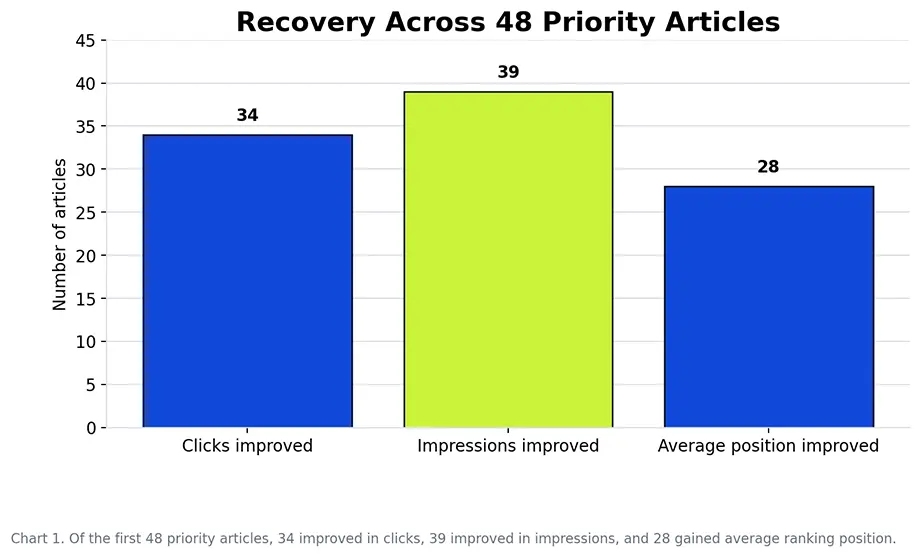
Out of the first 48 priority articles , 34 improved in clicks , 39 improved in impressions , and 28 gained average ranking position .
Several important pages recovered visibility:
- “monthly budget planner” improved from position 16 to 5
- “how to save money on groceries” improved from position 22 to 8
- “credit score improvement tips” improved from position 18 to 7
- “debt payoff strategy” improved from position 27 to 11
- “emergency fund calculator” improved from position 14 to 6
- “beginner investing guide” improved from position 21 to 10
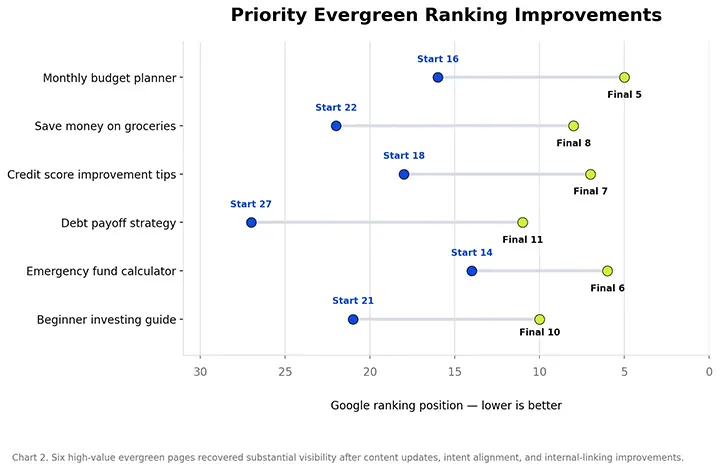
This showed that the recovery work was strongest where content updates, intent alignment, and internal linking were combined.
2. Organic Traffic Stabilisation
Before the coaching process, non-branded organic traffic had declined by 24% .
After the first recovery roadmap was implemented, non-branded organic traffic increased by 31% compared with the lowest traffic period.

The site did not return to its previous peak immediately, but the decline was stabilised and the highest-value content began moving in the right direction.
3. Higher Clicks on Updated Articles
Updated articles generated stronger engagement from search.
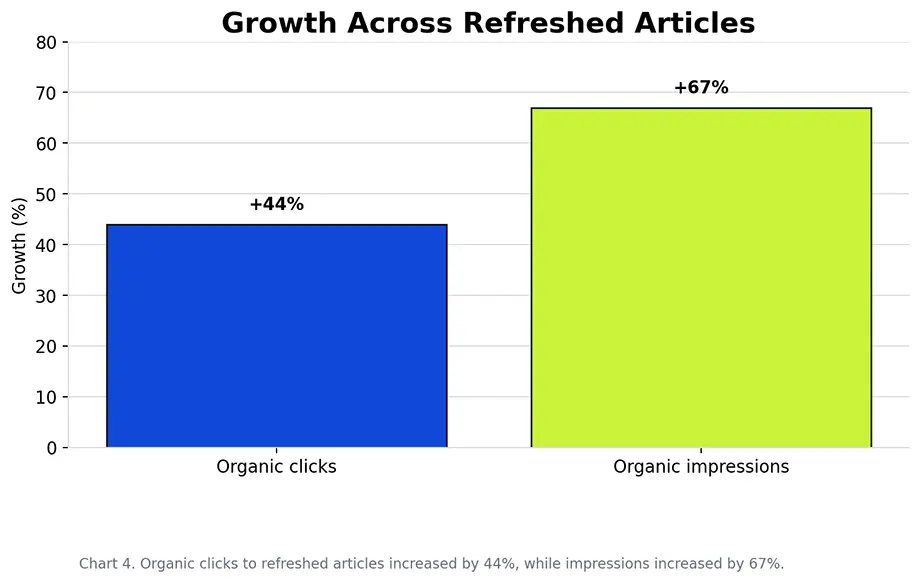
Organic clicks to the first group of refreshed articles increased by 44% .
Organic impressions increased by 67% , showing that Google was testing the improved content across a wider set of related queries.
The strongest single recovery came from the emergency fund calculator page:
- Organic clicks increased by 76%
- Impressions increased by 121%
- Average position improved from 14.2 to 6.1
- Newsletter signups from the page increased by 19%

4. Better Page-One Visibility
Before the project, the publisher had 52 page-one rankings across the tracked personal finance keyword set.
After the first update and consolidation cycle, page-one rankings increased to 89 .

The strongest gains came from budgeting, debt payoff, and emergency fund topics.
The site also gained more visibility for long-tail informational searches, especially questions around budgeting examples, savings plans, and credit score improvement timelines.
5. Reduced Content Overlap
AskSEOCoach identified 33 articles with overlap, cannibalisation, or low-value duplication.
After consolidation and pruning, the publisher reduced competing URLs around several key topics.
For example, four separate articles about grocery budgeting were merged into one stronger guide supported by examples, templates, FAQs, and internal links.
The consolidated guide improved from position 19 to 7 for its main query and started ranking for more than 80 related long-tail keywords .
6. Stronger Editorial Workflow
The editorial team completed 112 SEO actions during the coaching period.
Completed actions included:
- 48 priority article reviews
- 31 content updates
- 11 content merges
- 7 redirects
- 9 noindex decisions
- 86 internal links added or corrected
- 14 title and meta description rewrites
- 12 FAQ sections added
- 6 editorial review notes added
- 3 reporting views simplified
| Workstream | Completed actions |
|---|---|
| Priority article reviews | 48 |
| Content updates | 31 |
| Content merges | 11 |
| Redirects | 7 |
| Noindex decisions | 9 |
| Internal links added or corrected | 86 |
| Title and meta description rewrites | 14 |
| FAQ sections added | 12 |
| Editorial review notes added | 6 |
| Reporting views simplified | 3 |
| Total tracked SEO actions | 112 |
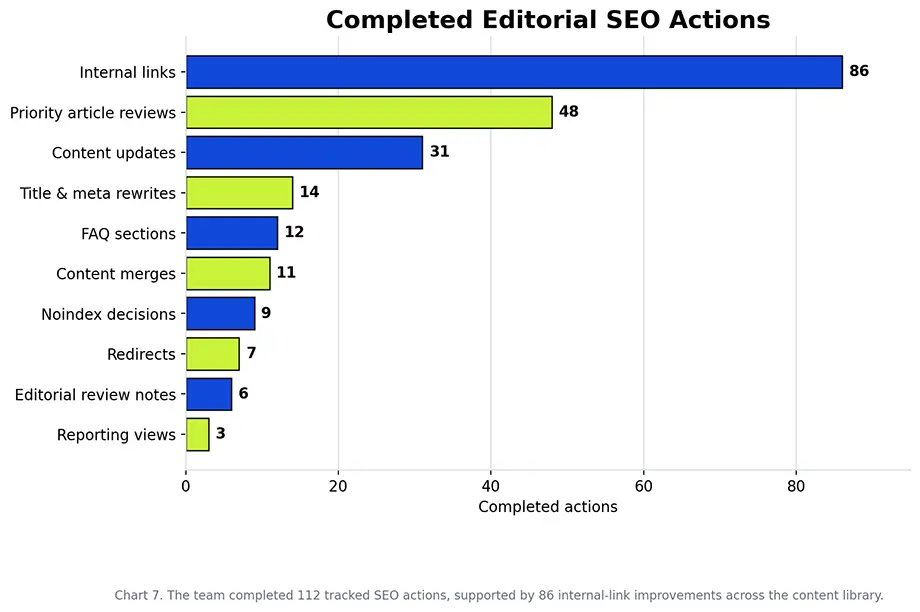
This gave the team a structured way to track progress and continue the process after the coaching engagement.
5. Progress and Achievements
The publisher moved from reacting emotionally to traffic drops to managing SEO with a clear editorial system.
Before working with AskSEOCoach, the team was unsure whether to update everything, publish more articles, or wait for rankings to recover naturally.
After the coaching process, the team had:
- A clear diagnosis of traffic volatility
- A prioritised content recovery list
- A content update workflow
- A framework for merging or pruning weak pages
- A stronger internal linking structure
- Better understanding of search intent changes
- A monthly reporting system focused on priority content
The team became more confident in deciding what to improve and what not to touch.
6. What Made the Coaching Valuable
AskSEOCoach did not simply say “refresh old content.” The coaching helped the publisher understand why certain pages declined and how to recover them strategically.
The team learned:
- How to separate normal ranking movement from real content decay
- How to identify pages with recovery potential
- How to re-check search intent before updating
- How to merge overlapping content without losing value
- How to strengthen internal links between related topics
- How to create a repeatable editorial SEO process
- How to measure recovery beyond traffic alone
This personal guidance helped the team regain control of SEO after a confusing period of volatility.
7. Outcome
Through dedicated SEO coaching, the personal finance publisher stabilised traffic, improved priority article visibility, and built a repeatable content recovery process.
The first recovery cycle helped increase non-branded organic traffic by 31% from the lowest point, improve organic clicks to refreshed articles by 44% , grow page-one rankings from 52 to 89 , and recover several high-value evergreen guides.
Most importantly, the publisher gained a stronger editorial SEO system for evaluating, updating, consolidating, and monitoring content over time.
What the Client Said
“Before working with AskSEOCoach, we were reacting to every traffic drop without knowing what to fix first. The coaching helped us understand which articles had real recovery potential, how to update them properly, and how to build a more consistent editorial SEO process.”
8. Frequently Asked Questions
The site had more than 620 indexable articles and uneven traffic losses, so the team needed a practical way to distinguish priority recovery opportunities from normal ranking movement and low-value content.
Articles were prioritised according to recovery potential, business value, traffic loss, search demand, content age, intent alignment, and their contribution to newsletter signups, affiliate clicks, or brand trust.
The decline was concentrated in specific groups of pages. Some articles remained stable, while others needed updates, consolidation, redirects, monitoring, or noindex decisions.
The team reviewed the current SERP, preferred content formats, People Also Ask questions, expert signals, fresher examples, calculators, templates, tables, and competitor improvements.
Overlapping and thin pages were merged into stronger evergreen resources, reducing competing URLs and concentrating relevance, internal links, and long-tail visibility.
Internal links connected related budgeting, savings, debt, credit, emergency fund, investing, calculator, and template content, helping users navigate the site and distributing authority to priority pages.
Organic clicks to the first group of refreshed articles increased by 44%, impressions increased by 67%, and several high-value evergreen pages returned to stronger page-one positions.
The emergency fund calculator increased organic clicks by 76%, impressions by 121%, improved average position from 14.2 to 6.1, and increased newsletter signups by 19%.
Yes. The same framework can be adapted to other editorial websites by diagnosing losses, classifying content, reassessing search intent, consolidating overlap, rebuilding internal links, and monitoring priority pages.
The next priorities should include ongoing content reviews, stronger expert and editorial signals, improved calculators and templates, deeper internal linking, and monthly monitoring of declining and recovering pages.
Continue exploring our SEO resources:
SEO for Accountants
SEO for Financial Advisors
SEO for Content Creators