1. Executive Summary
A growing UK e-commerce brand specialising in sustainable home décor approached AskSEOCoach after investing consistently in SEO without gaining a clear understanding of what was working.
The team was publishing blog articles, expanding product collections, optimising individual pages, and reviewing data from Google Search Console, Google Analytics, Shopify, and a keyword-tracking platform. However, the information remained fragmented across several tools.
The client could see rankings, impressions, clicks, transactions, and revenue, but could not confidently determine which pages deserved attention, which keywords had genuine commercial value, or which SEO activities were contributing to business growth.
The website already had a strong visual identity, a well-defined environmental positioning, and a growing product catalogue. The core problem was not a lack of content or products. It was the absence of a structured SEO system connecting search demand, page purpose, internal linking, commercial value, and performance reporting .
AskSEOCoach transformed the disconnected data into a prioritised organic growth roadmap centred on four areas:
- Commercial category-page optimisation
- Search-intent and keyword mapping
- Content-led product discovery
- Technical SEO and internal-linking improvements

2. Client Background & Initial Context
The client is a UK-based e-commerce retailer selling sustainable and responsibly sourced home décor products.
Its catalogue includes:
- Sustainable wall art
- Handmade ceramic vases
- Natural linen cushion covers
- Organic cotton throws
- Recycled-glass candle holders
- Eco-friendly tableware
- Seasonal decorative collections
The brand had already established a strong identity around ethical materials, responsible sourcing, and environmentally conscious interiors. Its product photography and visual merchandising were strong, and the website presented a credible premium image.
Despite this, organic visibility did not reflect the breadth or commercial potential of the catalogue.
At the beginning of the engagement:
- Only 38 tracked keywords ranked within Google’s top 100.
- Only 4 priority keywords ranked on page one.
- Most commercial collection pages ranked between positions 18 and 45.
- Blog articles generated impressions but rarely guided users toward relevant product collections.
- Category pages received limited contextual internal-link support.
- SEO reporting focused on individual metrics rather than commercial outcomes.
- The team had a long SEO task list but no consistent prioritisation process.
The business was therefore producing content and making SEO changes without knowing which actions were most likely to improve qualified traffic, product discovery, or revenue.
The client did not need more SEO data. It needed a reliable way to interpret the data it already had and turn it into clear business decisions.
3. SEO Challenges & Opportunities
Challenges
1. Disconnected SEO and commercial data
Google Search Console showed search visibility, Google Analytics reported sessions and user behaviour, Shopify provided transaction data, and the ranking platform monitored keyword positions.
Each platform offered useful information, but the reports were not connected into a single decision-making framework.
The team could not easily determine:
- Which category pages should be optimised first
- Which keywords were closest to generating revenue
- Which blog posts contributed to product discovery
- Whether rising impressions were translating into useful traffic
- Which technical warnings had meaningful SEO impact
- Which activities should be deprioritised
2. Weak commercial category-page visibility
The most commercially important collection pages were technically indexable, but most did not rank high enough to attract consistent clicks.
Several category pages lacked:
- Clear differentiation from closely related collections
- Well-aligned title tags and H1 headings
- Useful introductory category copy
- Contextual internal links
- Relevant FAQs
- Clear alignment with transactional search intent
3. Informational content disconnected from products
The brand had published articles about interior styling, environmentally responsible materials, seasonal decoration, and sustainable living.
Some articles attracted impressions and organic visits, but they operated almost independently from the product catalogue.
Articles rarely linked to relevant collections, and commercial pages rarely directed users toward educational content that could support a purchasing decision.
4. Too many competing SEO priorities
The client had identified dozens of potential actions, including:
- Rewriting metadata
- Adding category content
- Creating buying guides
- Compressing product images
- Improving structured data
- Removing filtered URLs from indexation
- Updating old blog articles
- Acquiring backlinks
- Improving internal linking
- Creating additional product collections
All of these actions could potentially help, but they did not have equal urgency, difficulty, or commercial impact.
Opportunities
1. Existing impressions on commercially relevant pages
Several category pages were already receiving impressions for transactional and mid-funnel queries. This indicated that Google understood their general relevance, but the pages needed stronger optimisation to compete for higher positions.
2. Realistic long-tail commercial demand
The keyword research identified specific searches with stronger purchase intent and more achievable competition than broad home décor terms.
Examples included:
- Sustainable wall art UK
- Handmade ceramic vases
- Natural linen cushion covers
- Eco-friendly home accessories
- Recycled-glass candle holders
- Sustainable tableware sets
- Organic cotton throws
3. Strong potential for content-assisted product discovery
The existing editorial library created a valuable foundation. Rather than starting from zero, the team could update and reposition existing content so that it supported commercial collections and helped visitors progress from inspiration to product consideration.
4. Significant upside from better internal linking
High-impression articles and strong product collections were not sufficiently connected. A clearer internal-linking framework offered a relatively fast way to improve topical relationships, crawl paths, and user journeys.
4. Strategy & Implementation
Creating a Business-Led SEO Roadmap
AskSEOCoach began by consolidating search, analytics, ranking, and sales data into one practical roadmap.
Rather than delivering an oversized technical audit containing hundreds of disconnected recommendations, every action was evaluated according to:
- Expected commercial impact
- Existing organic opportunity
- Implementation difficulty
- Estimated time to measurable results
- Relationship to wider site architecture
The roadmap was then organised into four priorities:
- Strengthen high-value commercial collection pages
- Connect informational content to product discovery
- Improve internal linking and site architecture
- Resolve technical issues affecting crawling, indexation, and performance
Mapping Keywords to Intent and Page Type
The keyword strategy was rebuilt around search intent and commercial value rather than search volume alone.
Keyword groups were assigned to the page type most capable of satisfying the search:
- Collection pages: broad transactional searches
- Subcollections: specific product groups or materials
- Buying guides: commercial investigation and product comparison
- Educational articles: informational and inspiration-led searches
- Seasonal landing pages: time-sensitive product demand
Each strategic page was assigned one primary search role. This reduced overlap between collections and lowered the risk of keyword cannibalisation.

Optimising Priority Category Pages
Twelve high-value category pages were selected according to commercial relevance, existing impressions, ranking potential, and product availability.
The optimisation work included:
- Rewriting title tags around primary commercial intent
- Clarifying H1 and supporting heading structures
- Adding useful category introductions
- Expanding content where additional guidance supported purchasing decisions
- Adding FAQs based on real search questions
- Improving image alternative text
- Correcting internal links that passed through redirects
- Validating product and collection structured data
- Connecting closely related product categories
- Adding contextual links from relevant editorial content
The objective was not to add large blocks of generic SEO copy. Category content was written to help customers understand materials, dimensions, styling options, sustainability characteristics, and product suitability.
| Search Topic | Starting Position | Final Position | Improvement |
|---|---|---|---|
| Sustainable wall art UK | 42 | 8 | +34 positions |
| Handmade ceramic vases | 31 | 6 | +25 positions |
| Natural linen cushion covers | 27 | 9 | +18 positions |
| Eco-friendly home accessories | 54 | 14 | +40 positions |
| Recycled-glass candle holders | Outside top 100 | 11 | New top-20 ranking |
| Sustainable tableware sets | 38 | 12 | +26 positions |

Repositioning the Content Strategy
Existing editorial content was reviewed according to organic visibility, topical relevance, business value, and connection to the product catalogue.
Each article was assigned one of four actions:
- Retain without major changes
- Update and expand
- Consolidate with another page
- Redirect or remove when it no longer served a useful purpose
The goal was to stop treating the blog as an isolated inspiration area and turn it into a product-discovery resource.
Examples included:
- A guide to decorating a small living room sustainably was linked to wall art, cushion, throw, and lighting collections.
- A guide to selecting handmade ceramics was connected to ceramic vase, tableware, and decorative-object collections.
- An article about environmentally responsible table styling supported recycled-glass and sustainable tableware pages.
- A natural-textile guide linked to linen cushions and organic cotton throws.
Building a Repeatable Internal-Linking Framework
A practical linking system was introduced so that future improvements would not depend on isolated manual decisions.
The framework covered:
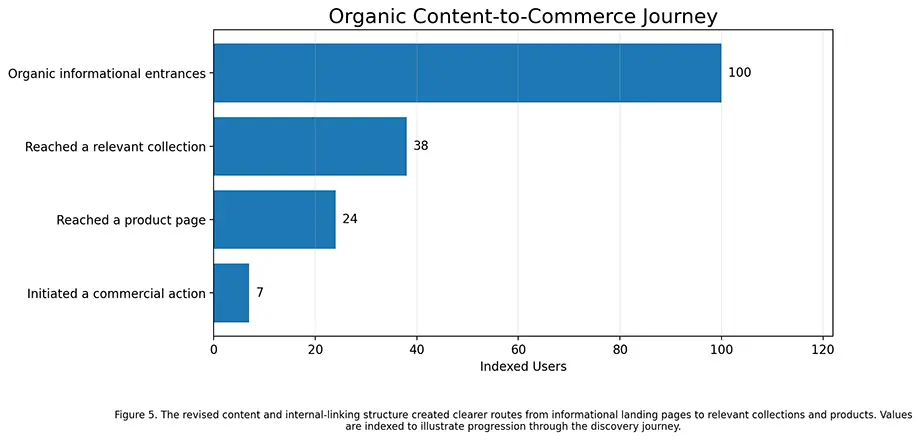
- Editorial article-to-category links
- Buying guide-to-collection links
- Related category-to-category links
- Product-to-parent-category links
- Seasonal page connections
- Links from high-traffic articles to relevant commercial destinations
- Links from commercial pages to supporting educational resources
A total of 41 contextual internal links were added or corrected during the engagement.
Prioritised Technical SEO Cleanup
The technical review focused on issues capable of affecting organic performance rather than attempting to eliminate every minor warning reported by an auditing tool.
The prioritised work included:
- Preventing low-value filtered URLs from being indexed
- Removing noncanonical URLs from the XML sitemap
- Correcting internal links pointing to redirected product URLs
- Resolving duplicate title tags across collection templates
- Improving product-image compression and delivery
- Validating product and collection structured data
- Reviewing canonical tags across filtered and paginated URLs
- Ensuring strategic pages received crawlable internal links
- Updating the sitemap to contain only canonical, indexable URLs
5. Results & Performance Metrics
Performance was assessed using a combination of search visibility, commercial-page engagement, product discovery, implementation progress, and organic-assisted revenue.
Keyword Visibility
| KPI | Baseline | Final Result | Change |
|---|---|---|---|
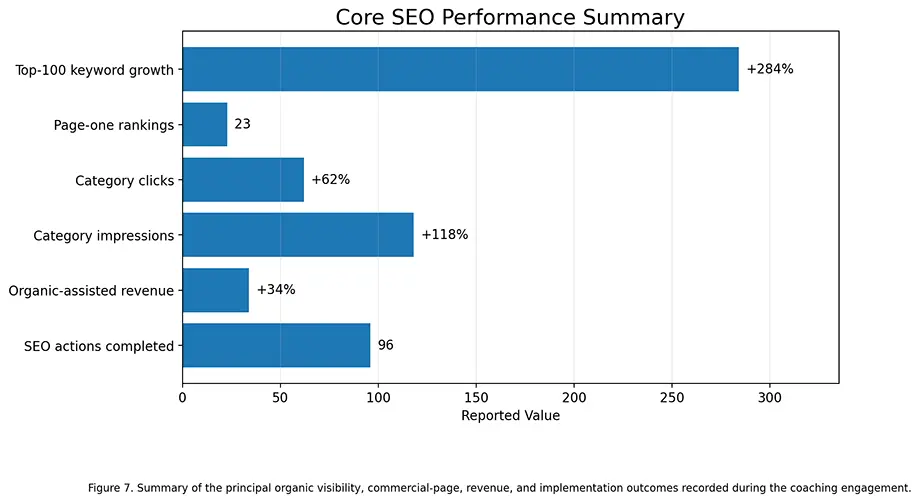
| Tracked keywords in Google’s top 100 | 38 | 146 | +284% |
| Top-20 keyword rankings | 11 | 67 | +509% |
| Page-one keyword rankings | 4 | 23 | +475% |
Commercial Category-Page Performance
| KPI | Measured Result | Primary Data Source |
|---|---|---|
| Organic clicks to priority category pages | +62% | Google Search Console |
| Organic impressions for collection pages | +118% | Google Search Console |
| Product-page visits from category entrances | +39% | Google Analytics 4 |
| Organic-assisted revenue | +34% | GA4 and Shopify attribution |
Best-Performing Commercial Collection
The handmade ceramics collection recorded the strongest individual improvement:
- +74% organic clicks
- +136% organic impressions
- Average position improved from 28.4 to 11.7
Organic-Assisted Revenue Growth
As commercial pages gained visibility and informational content became more closely connected to products, organic search contributed more meaningfully to revenue.
Organic-assisted revenue increased by 34% during the comparison period.
Revenue was displayed as an index rather than an absolute amount to preserve commercial confidentiality while still communicating the direction and scale of growth.

Implementation Output
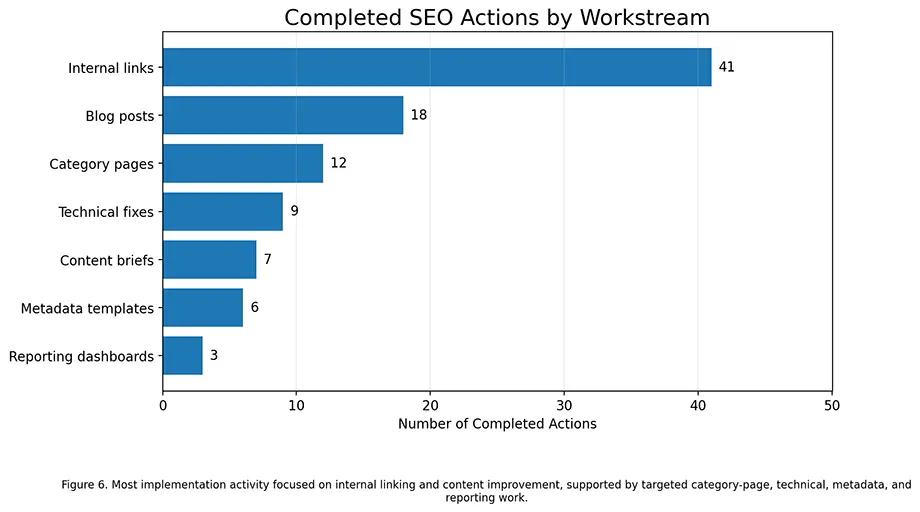
The project produced 96 completed SEO actions across content, commercial pages, internal linking, technical SEO, metadata, and reporting.
| Workstream | Completed Actions |
|---|---|
| Category pages optimised | 12 |
| Existing blog posts updated | 18 |
| New content briefs created | 7 |
| Internal links added or corrected | 41 |
| Technical SEO fixes | 9 |
| Metadata templates improved | 6 |
| Reporting dashboards simplified | 3 |
| Total | 96 |
Core Performance Summary
6. Business Impact & Next Steps
Business Impact
The most important transformation was not limited to keyword rankings.
Before the coaching engagement, the client had access to extensive data but no consistent method for turning that data into decisions. SEO activity was reactive, and priorities frequently changed according to the latest report, tool warning, or content idea.
By the end of the engagement, the team had a repeatable process:
- Identify search demand connected to real products and customer needs.
- Map each search intent to the correct page.
- Prioritise pages according to opportunity and commercial value.
- Improve existing commercial pages before creating unnecessary new content.
- Use informational content to support product discovery.
- Strengthen internal relationships between related pages.
- Resolve technical problems according to likely business impact.
- Monitor leading indicators and commercial outcomes separately.
- Adjust the roadmap using monthly performance data.
This gave the internal team greater confidence when deciding what to optimise, what to publish, and what to deprioritise.
Why the Coaching Approach Worked
AskSEOCoach did not simply provide a list of recommendations and leave the client to interpret it.
The team was guided through the reasoning behind each decision, including:
- Why commercial category pages deserved priority over unrelated blog production
- How to evaluate keywords using intent and business relevance
- How to distinguish visibility metrics from business outcomes
- How to improve category content without adding generic text
- How to connect informational pages to commercial collections
- How to identify valuable internal-linking opportunities
- How to prioritise technical issues according to their likely impact
- How to monitor performance without reacting to every short-term ranking fluctuation
SEO became easier to manage because every keyword, page, article, link, and technical action had a clearer role within the wider commercial strategy.
Forward-Looking Recommendations
1. Continue expanding high-performing collections
Collections already ranking between positions 6 and 15 should be reviewed regularly for opportunities to strengthen supporting copy, internal links, FAQs, product availability, and conversion elements.
2. Build supporting content around product decisions
Future content should focus on questions that influence product selection, including materials, dimensions, care instructions, sustainability claims, room suitability, styling combinations, and gift selection.
3. Maintain strict keyword and page ownership
Every new category, guide, or seasonal page should be mapped before publication. This will help prevent future cannibalisation and keep the architecture understandable as the catalogue expands.
4. Monitor filtered and faceted navigation
Product filters can create large numbers of low-value URLs. Indexation, canonical tags, internal links, and crawl behaviour should therefore be reviewed as product ranges and filter options expand.
5. Improve product-level search visibility
The next stage should include stronger product titles, descriptions, merchant feed data, Product structured data, review signals, image optimisation, and alignment between organic search and Google Merchant Center.
6. Review performance quarterly
Quarterly reviews should evaluate keyword movement, category-page visibility, content-assisted journeys, product discovery, technical health, revenue contribution, and declining pages.
7. Strengthen first-party trust signals
The brand should continue documenting sourcing methods, material standards, manufacturing processes, product care information, and sustainability evidence. These details can strengthen both user trust and content differentiation.
What the Client Said
"Before working with AskSEOCoach, we had SEO data from several tools but no clear direction. The coaching helped us understand which pages mattered, how to prioritize our actions, and how to connect content with real product visibility. SEO became much easier to manage and much more connected to business growth."
7. Frequently Asked Questions
Category pages were closer to the client’s commercial goals and were already receiving impressions for transactional searches. Improving these pages offered a clearer opportunity to increase qualified traffic and product discovery than publishing additional unrelated informational content.
Pages were assessed according to commercial importance, existing impressions, ranking position, product availability, keyword potential, competition, and implementation difficulty. This helped identify pages where optimisation was both realistic and valuable.
Optimising every page simultaneously would have spread resources too thinly and made the impact harder to measure. The strategy focused first on twelve high-opportunity collections, allowing the team to test the framework, monitor results, and apply successful patterns to additional pages later.
Internal links connected informational articles with relevant collections, related categories with one another, and product pages with their parent collections. This improved crawl paths, clarified topical relationships, distributed internal authority, and gave visitors clearer routes toward relevant products.
Yes. The blog remained valuable, but its role changed. Instead of operating as a separate inspiration section, it became a support system for commercial collections by answering customer questions and guiding users toward relevant products.
Each strategic keyword group was mapped to one primary page type and one intended destination. Similar collections and articles were reviewed for overlapping intent, and pages were differentiated, consolidated, or repositioned where necessary.
Indexed figures make it possible to show the direction and percentage of revenue growth without disclosing confidential financial data. A baseline value of 100 was used, with the final value of 134 representing 34% growth.
Priority was given to issues affecting crawling, indexation, canonicalisation, internal signals, page performance, and structured data. Minor warnings with little practical impact were deprioritised.
Initial movement appeared after the first category-page, content, and internal-linking improvements were implemented. More substantial gains developed progressively across the twelve-month measurement period as Google recrawled pages and the full roadmap was executed.
Yes. The underlying framework can be adapted to other e-commerce sectors: prioritise commercially important pages, map search intent carefully, connect content to products, strengthen internal linking, resolve technical barriers, and measure both visibility and business outcomes.
The next priorities are expanding successful category-page patterns, improving product-level SEO, strengthening sustainability and trust signals, monitoring faceted navigation, and continuing quarterly performance reviews.
Explore our e-commerce SEO guide to learn how to build a stronger SEO strategy.