1. Executive Summary
A Manchester dental clinic approached AskSEOCoach to improve visibility for high-intent local searches and generate more qualified appointment enquiries through Google Search and Google Maps.
Although the clinic already had treatment pages and an active Google Business Profile, its SEO activity was fragmented. Priority services such as emergency dentistry, implants, orthodontics, cosmetic treatments, and private dental care had limited visibility, while several important pages ranked outside Google’s first two results pages. The profile was underused, review growth was slow, and the website did not fully address the questions prospective patients ask before booking.
The strategy focused on five connected areas:
- Mapping local keywords to individual treatment pages
- Improving the content and structure of priority service pages
- Optimising the Google Business Profile
- Building a consistent patient-review workflow
- Creating a monthly local SEO reporting routine
The results included:
- Tracked top-100 keywords increased from 21 to 79
- Page-one treatment rankings increased from 3 to 14
- Organic clicks to priority service pages increased by 57%
- Google Business Profile calls increased by 48%
- Google reviews increased from 86 to 128
- A total of 84 local SEO actions were completed

2. Initial Local SEO Challenges
Weak Visibility for High-Intent Treatment Searches
The clinic had some visibility for branded searches but ranked poorly for the treatment-related terms most likely to generate appointments.
At the start of the project, several commercially important searches ranked outside the top 20:
- Emergency dentist Manchester
- Dental implants Manchester
- Invisalign Manchester
- Teeth whitening Manchester
- Private dentist Manchester
- Composite bonding Manchester
These searches represented significant opportunities because the users performing them were often actively comparing clinics, checking availability, reviewing treatment options, or preparing to book.
The problem was not a complete absence of relevance. Several pages were already receiving impressions. However, their rankings were too low to generate a consistent share of local clicks.
Google Business Profile Was Underused
The clinic had an existing Google Business Profile, but it was being treated primarily as a business listing rather than an active local search asset.
The profile contained basic contact information, but several elements were incomplete or inconsistent:
- Primary and secondary categories needed refinement
- Treatment services lacked detailed descriptions
- New photos were added irregularly
- Review responses were inconsistent
- Google posts were published without a clear schedule
- Appointment and website links were not fully optimised
- Review growth was slower than that of several local competitors
The profile generated some discovery and branded activity, but its contribution to calls, website visits, and direction requests remained below its potential.
Treatment Pages Were Too Generic
The clinic had dedicated pages for major treatments, but several pages followed nearly identical structures and contained limited information.
Pages covering implants, Invisalign, teeth whitening, hygiene appointments, and emergency dentistry often lacked:
- Strong locally focused title tags
- Clear H1 and supporting H2 structures
- Detailed explanations of the treatment process
- Information about suitability, recovery, cost factors, and appointment expectations
- Patient-focused FAQs
- Contextual links to related treatments
- Clear appointment calls to action
- Strong trust and clinical-experience signals
The pages described the treatment, but they did not fully satisfy the informational and commercial questions patients ask before contacting a clinic.
No Consistent Monthly SEO Workflow
Website updates, Google Business Profile posts, review requests, and reporting were completed occasionally rather than as part of a defined process.
The team did not have clear answers to questions such as:
- Which treatment page should be improved next?
- Which local keywords had the strongest booking intent?
- Which Google Business Profile metrics mattered most?
- When did a page require more content rather than more links?
- How should review growth be measured?
- Which competitor changes required a response?
SEO remained a collection of disconnected tasks instead of a managed acquisition channel.
3. Local SEO Strategy
Local SEO Audit and Opportunity Assessment
AskSEOCoach began with a practical audit covering:
- Organic search visibility
- Google Business Profile configuration
- Local pack competitors
- Priority treatment pages
- Internal linking
- Page titles and headings
- Review quantity and recency
- Structured data
- Indexation and crawlability
- Local citations and business information
- Appointment-conversion paths
The audit findings were explained during coaching sessions so the clinic team could understand not only what needed to change, but why each action mattered.
Recommendations were prioritised according to:
- Booking intent
- Commercial value of the treatment
- Existing search visibility
- Competitive difficulty
- Implementation effort
- Likely time to impact
This prevented minor technical warnings from taking priority over treatment pages and local profile improvements with stronger appointment potential.
Local Keyword and Intent Mapping
The clinic’s services were mapped to distinct local search-intent groups:
- Emergency dentistry
- Dental implants
- Invisalign and clear aligners
- Teeth whitening
- Private dental care
- Dental hygiene appointments
- Composite bonding
Each primary keyword group was assigned to one main landing page.
Related long-tail searches were then grouped around patient questions such as:
- Treatment cost
- Appointment availability
- Treatment duration
- Suitability
- Recovery
- Pain and anaesthesia
- Results
- Alternatives
- Aftercare
This created clearer page ownership and reduced the risk that multiple treatment pages would compete for the same local intent.
4. Treatment-Page Optimisation
The clinic’s highest-value treatment pages were improved first.
The optimisation work included:
- Stronger title tags combining treatment and local intent
- Clearer H1 and H2 structures
- More complete treatment explanations
- Patient-centred FAQs
- Better links between related services
- Clearer calls to book or contact the clinic
- Manchester-specific relevance signals
- Clinical experience and patient-care information
- Improved image alternative text
- Structured data validation
The objective was not simply to add more words. Each page needed to help prospective patients understand the treatment, decide whether it might be appropriate, and identify the next step.
Eight existing treatment pages were optimised, and a new composite bonding page was created.
Priority Ranking Improvements
| Search query | Starting position | Final position | Improvement |
|---|---|---|---|
| Emergency dentist Manchester | 34 | 7 | 27 positions |
| Private dentist Manchester | 28 | 9 | 19 positions |
| Invisalign Manchester | 41 | 13 | 28 positions |
| Teeth whitening Manchester | 22 | 8 | 14 positions |
| Dental implants Manchester | 37 | 15 | 22 positions |
| Composite bonding Manchester | Outside top 100 | 18 | New top-20 ranking |

5. Google Business Profile Optimisation
The Google Business Profile was rebuilt as an active local acquisition channel rather than a static listing.
The work included:
- Refining the primary and secondary categories
- Adding detailed descriptions for priority treatments
- Reviewing the business description
- Improving appointment and website links
- Adding new treatment, clinic, and team photos
- Creating a consistent Google post schedule
- Improving review-response frequency
- Connecting individual services to relevant website landing pages
- Monitoring calls, website clicks, direction requests, and search views
The clinic also learned how profile performance is influenced by several connected factors:
- Relevance of business categories
- Proximity to the searcher
- Review quantity, recency, and quality
- Completeness of treatment information
- Website landing-page relevance
- Local prominence and citations
- User interaction with the profile
Google Business Profile Results
During the comparison period:
- Calls increased by 48%
- Direction requests increased by 37%
- Website clicks increased by 52%
- Treatment-related profile views increased by 31%

6. Review Growth and Local Trust
Because dental treatments involve health, cost, and personal trust, reviews played an important role in both local visibility and patient decision-making.
AskSEOCoach helped the clinic establish a post-appointment review process that was:
- Consistent
- Ethical
- Easy for staff to manage
- Non-incentivised
- Suitable for satisfied patients
- Supported by professional review responses
The process included:
- Identifying an appropriate point in the patient journey
- Providing a direct review link
- Training staff to request feedback naturally
- Responding to positive and neutral reviews
- Avoiding pressure or selective review gating
- Monitoring review growth and recency monthly
The clinic increased its Google review total from 86 to 128 , while maintaining an average rating of 4.8 stars .

7. Stronger Service-Page Performance
The optimised treatment pages generated measurable growth in both visibility and organic traffic.
Across priority service pages:
- Organic clicks increased by 57%
- Organic impressions increased by 102%
- More pages appeared for cost, availability, and treatment-related long-tail searches
- Visitors received clearer routes to related treatments and appointment actions
The emergency dentistry page recorded the strongest individual improvement:
- Organic clicks increased by 83%
- Impressions increased by 147%
- Average position improved from 31.6 to 9.4
The Invisalign page also improved steadily after its content was expanded and supporting internal links were added.

8. A Repeatable Monthly Local SEO Routine
A monthly workflow was created so the clinic could continue improving its performance without relying on irregular SEO activity.
Each month, the team reviewed:
- Google Business Profile calls
- Direction requests
- Website clicks from the profile
- Treatment-page impressions and clicks
- Local keyword movement
- New and recent reviews
- Competitor profile and content changes
- Pages losing visibility
- Pages approaching page-one positions
- Completed SEO actions
- Priorities for the following month
The reporting process separated leading indicators from business outcomes.
Leading Indicators
- Search impressions
- Ranking improvements
- Local pack visibility
- Review growth
- Indexation
- Google Business Profile views
Commercial Outcomes
- Calls
- Appointment requests
- Website conversions
- Direction requests
- Visits to high-value treatment pages
This helped the team understand that local SEO improvements often happen in stages: a page may first receive more impressions, then achieve a higher position, then attract more clicks, and finally generate more appointment activity.
9. Completed Local SEO Actions
The engagement included 84 completed actions across website content, Google Business Profile optimisation, internal linking, reviews, technical SEO, and reporting.
| Workstream | Completed actions |
|---|---|
| Treatment pages optimised | 8 |
| New composite bonding page | 1 |
| Google Business Profile service sections | 6 |
| Internal links added or corrected | 22 |
| FAQs added | 14 |
| Image and alt-text improvements | 9 |
| Review workflow actions | 12 |
| Technical SEO fixes | 5 |
| Reporting improvements | 7 |
| Total | 84 |

10. Core Performance Summary
The clinic improved its visibility across both traditional organic search and Google Maps.
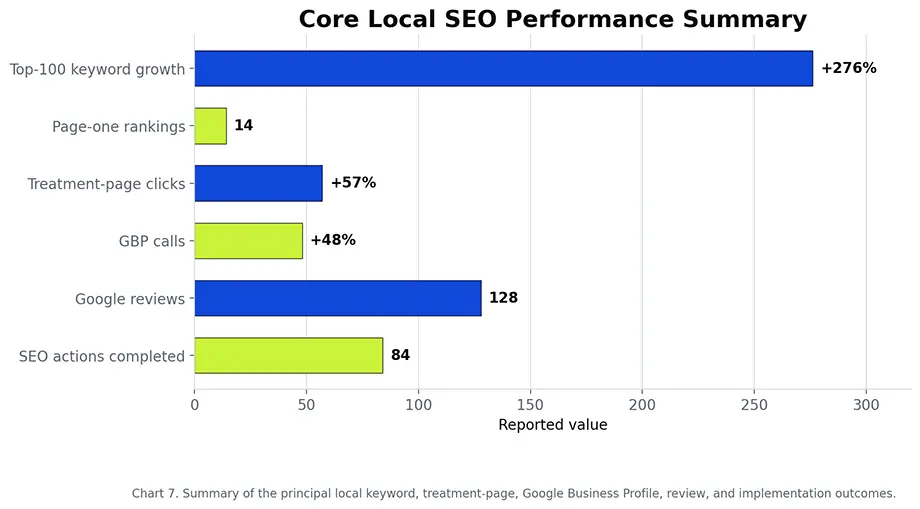
The most important recorded outcomes were:
| KPI | Baseline | Final result |
|---|---|---|
| Keywords in Google’s top 100 | 21 | 79 |
| Page-one treatment rankings | 3 | 14 |
| Organic clicks to priority pages | — | +57% |
| Google Business Profile calls | — | +48% |
| Google reviews | 86 | 128 |
| Completed SEO actions | 0 | 84 |
11. Progress Beyond Rankings
The most important change was not limited to keyword positions.
Before the engagement, the clinic’s SEO work was occasional and reactive. The team did not have a clear method for deciding which treatment pages mattered most, how to manage the Google Business Profile, or which metrics should guide monthly actions.
After the coaching process, the clinic had:
- A clear local keyword map
- Stronger treatment pages
- A more complete and active Google Business Profile
- A consistent review-acquisition workflow
- Better links between related treatments
- A monthly reporting routine
- Clearer appointment-focused performance indicators
- Greater confidence in prioritising local SEO work
The clinic also developed a better understanding of how website visibility, Google Maps exposure, reviews, and patient enquiries interact.
12. Why the Strategy Worked
The project did not rely on one isolated optimisation.
The results came from aligning several local search signals around the same commercial priorities:
- High-intent keywords were mapped to appropriate treatment pages.
- Treatment pages were expanded around real patient questions.
- Internal links clarified relationships between related services.
- The Google Business Profile was connected more closely to website content.
- Review acquisition strengthened trust and local prominence.
- Reporting connected visibility metrics with patient actions.
- Monthly routines ensured improvements continued after the initial work.
The clinic was not simply given a checklist. Its team was guided through the reasoning behind each decision and learned how to maintain the system independently.
13. Outcome
Through a structured local SEO process, the Manchester dental clinic improved its ability to attract prospective patients through both Google Search and Google Maps.
The clinic increased tracked top-100 keywords from 21 to 79 , expanded page-one treatment rankings from 3 to 14 , grew organic clicks to priority service pages by 57% , and increased Google Business Profile calls by 48% .
Its review total increased from 86 to 128 , while the average rating remained stable at 4.8 stars .
Most importantly, the clinic gained a repeatable local SEO system that its team could continue using to review performance, prioritise treatments, improve local pages, manage its Google Business Profile, and support patient acquisition.
What the Client Said
“Before working with AskSEOCoach, we had a website and a Google profile, but no real SEO system. The coaching helped us understand which treatments to prioritise, how to improve our local pages, how to manage our Google profile, and how to track progress every month.”
7. Frequently Asked Questions
Treatment pages were closest to appointment intent and already received impressions for valuable local searches.
Pages were assessed according to treatment value, booking intent, visibility, competition, implementation effort, and appointment potential.
Stronger categories, detailed services, better links, fresh photos, regular posts, and consistent review responses supported more local interactions.
Reviews influence patient trust and can strengthen local prominence.
Each treatment keyword group was mapped to one primary page.
Issues affecting crawling, indexation, internal linking, structured data, mobile usability, and performance were prioritised.
Initial gains appeared after key pages and the Google Business Profile were updated; larger gains developed progressively.
Yes. The framework can be adapted to other dental practices and local markets.
High-performing pages, local authority, review growth, conversion tracking, and monthly competitor monitoring.
Explore our SEO for doctors and SEO for therapists guides to learn how to build a stronger local search strategy.